A used street sweeper can put a capable machine on the street for a fraction of a new unit’s cost, but only if the one you buy is mechanically sound. A thorough used street sweeper inspection separates a reliable workhorse from a fresh coat of paint over worn-out systems. This guide walks municipal fleet managers and contractors through exactly what to check before you sign.
Key Takeaways
Here is the quick version of the full inspection below.
- Appearance does not equal mechanical condition. New paint can hide worn brooms, a tired auxiliary engine, or a cracked hopper, so inspect systems instead of looks.
- Street sweepers are high-wear, often dual-engine machines. Check the auxiliary sweeper engine hours separately from the chassis mileage, because the two rarely match.
- The sweeping system, hopper and conveyor, water system, blower, and hydraulics each wear differently. Inspect each one against how the unit was actually used.
- Corrosion matters most on units run in salt and snow regions. Check the frame, subframe, and hopper for rust-through, not just surface rust.
- Maintenance records and accurate hour meters tell you more than a low price. A documented service history is one of the strongest signals of a well-kept machine.
- A dealer-reconditioned sweeper rebuilt with OEM parts and tested before sale offers more buyer protection than a private-party unit sold as-is.
Why a Used Street Sweeper Needs a Closer Look Than a Standard Truck
A used street sweeper carries far more wear-prone systems than a standard truck, so a surface-level walkaround is not enough. Beyond the chassis you drive, you are buying several systems a standard truck does not have:
- A sweeping head with gutter brooms, a main broom or pickup head, and wear strips.
- A hopper and conveyor that move and store abrasive debris load after load.
- A water and dust suppression system with a pump, tank, and spray nozzles.
- On many units, a second engine that powers the sweeping system independently of the chassis.
The most common buying mistake is trusting fresh paint. A repaint is cheap, and a rebuilt sweeping system is not. Ranger Kidwell-Ross, Executive Director of the World Sweeping Association, advises buyers to begin a truck-mounted inspection at the front of the chassis and check the front suspension for substantial wear, then work methodically through the rest of the unit rather than judging it by how it looks.
Brown Equipment Company has sold, serviced, and reconditioned municipal sweeping and road equipment across the Midwest since 1968. The same principle holds on every used unit that comes through the shop: condition is earned through maintenance, not paint.
How Do You Inspect a Used Street Sweeper?
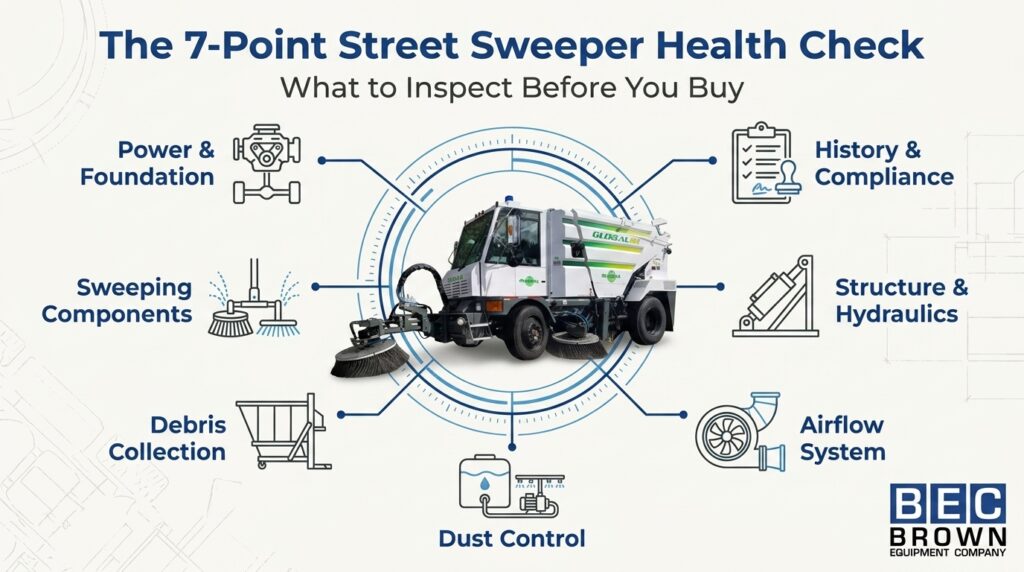
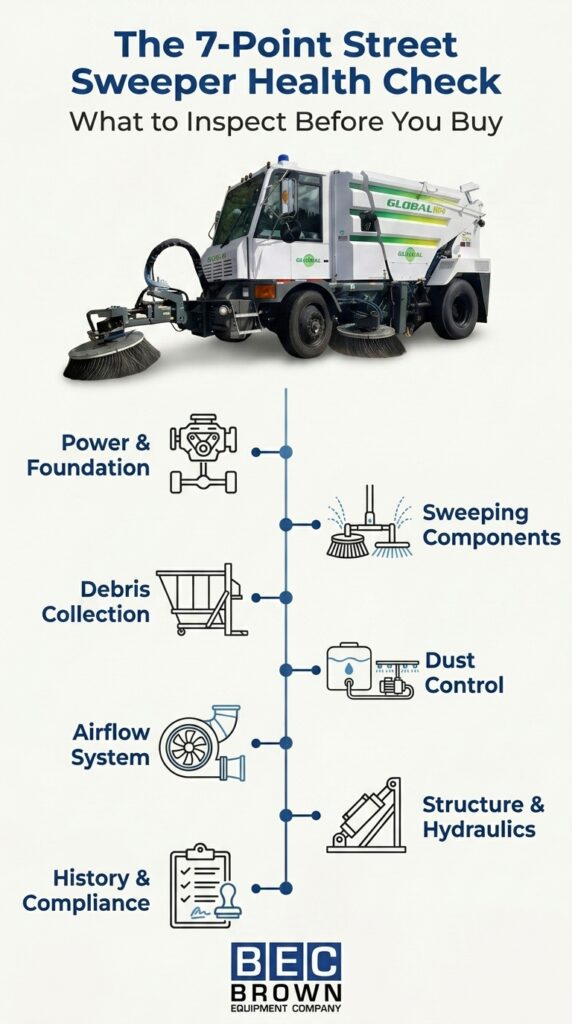
To inspect a used street sweeper, work through it system by system: the chassis and engines, the sweeping system, the hopper and conveyor, the water and dust suppression system, the blower and vacuum components, the hydraulics, and the frame, then verify everything against the maintenance records. Start the unit cold, run every function, and watch it actually pick up material before you commit.
Use the checklist below as a field guide. Each system wears at a different rate, so match what you see against how hard the machine was worked.
Start With the Chassis, Engines, and Hour Meters
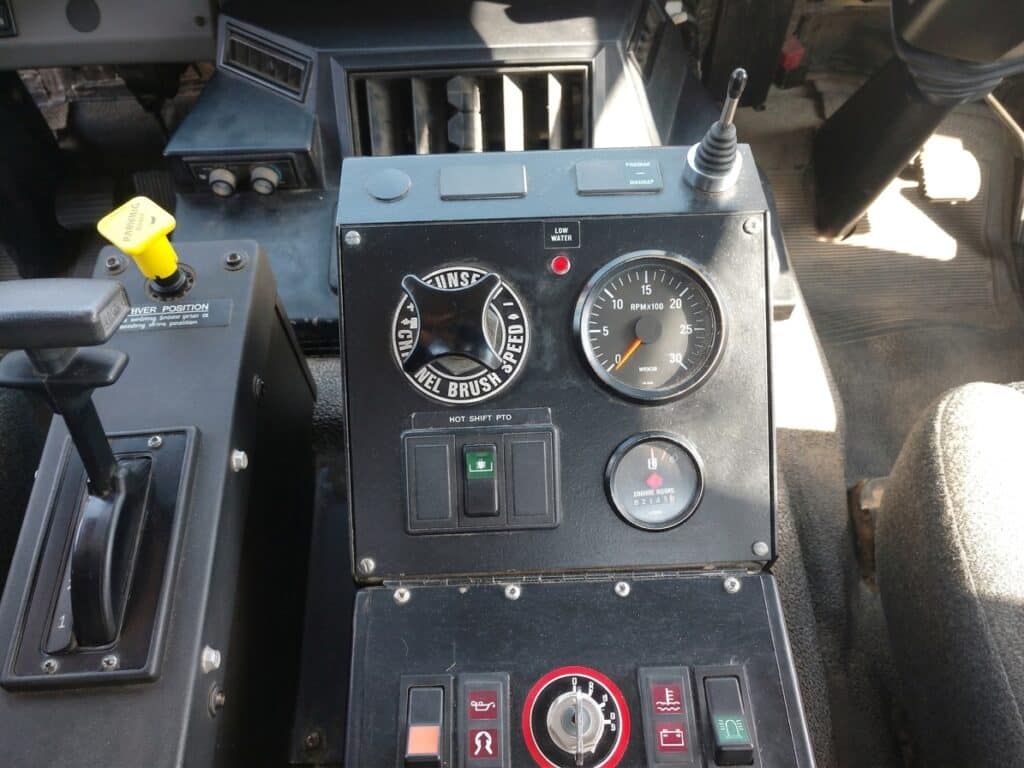
Begin where wear is easiest to miss. Many street sweepers run a dual-engine setup, with a chassis engine for driving and a separate auxiliary engine that powers the sweeping system.
- Auxiliary engine hours: Check the sweeper engine hours separately from the chassis mileage, since low road miles can still hide a heavily used auxiliary engine.
- Cold start: Start both engines cold and listen for hard starting, excessive smoke, or knocking.
- Fluids and leaks: Look for oil and coolant leaks, milky oil, and low or burnt fluids on both engines.
- Chassis and suspension: Check the front suspension, steering, brakes, and tires for wear consistent with the reported hours.
Brooms, Brushes, and the Pickup Head
The sweeping system is the hardest-working part of the machine and the most telling. Worn brooms are normal, but uneven wear can point to a larger alignment or frame problem.
- Gutter brooms and main broom: Measure remaining bristle or strip length and note how soon replacements will be due.
- Wear pattern: Uneven or angled wear can signal a bent broom arm, worn bearings, or a frame issue.
- Wear strips and adjustment: Check the broom wear strips and confirm the down-pressure adjustment still works.
- Pickup head: On vacuum and regenerative air units, inspect the pickup head, skid plates, and flaps for wear and damage.
Hopper and Conveyor System
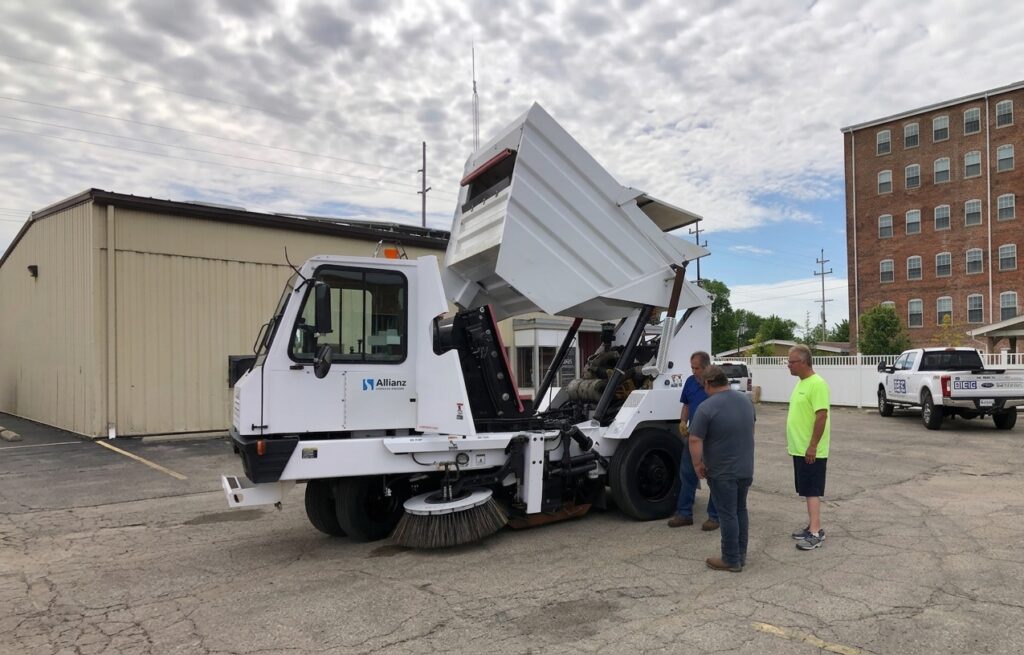
The hopper takes constant abrasion and the conveyor moves every bit of debris collected, so both are prime spots for hidden damage. Raise and dump the hopper and look inside, not just at the exterior.
- Cracks and rust-through: Inspect the hopper floor and walls for cracks, rust-through, and past weld repairs.
- Conveyor or belt: On mechanical units, check the conveyor chain or belt, flights, and squeegees for wear and stretch.
- Dump function: Cycle the hopper lift fully and watch for slow, jerky, or uneven operation.
- Seals: Check the hopper door and dust seals, which control both spillage and dust escape.
Water and Dust Suppression System
The water system controls dust during sweeping, and clogged or corroded components are common on neglected units. Run the system and confirm water actually reaches every spray point.
- Pump and tank: Check the water pump for leaks and the tank for cracks, sediment, and corrosion.
- Spray bars and nozzles: Run the spray bars and look for clogged or missing nozzles and weak flow.
- Plumbing: Inspect the hoses, fittings, and filter for clogging and leaks.
Blower, Fan, and Vacuum Components
On regenerative air and pure-vacuum sweepers, the blower or fan does the work that brooms do on a mechanical unit, and it wears where you cannot see it. These parts are expensive to replace, so inspect them closely.
- Fan and housing: Check the blower or fan blades and the fan housing for wear, thinning, and impact damage.
- Ducting and hoses: Inspect the ducting, suction hoses, and elbows for abrasion and holes.
- Suction and seals: Confirm the system holds suction. Weak suction often means worn seals or a tired fan.
Hydraulics, Frame, and Corrosion
Hydraulics run the hopper, brooms, and lift functions, and the frame holds it all together. Both reward a careful look, especially on sweepers run through Midwest winters.
- Hydraulic leaks: Check the cylinders, hoses, and fittings for leaks and inspect the fluid quality.
- Cylinder condition: Look for scored or pitted cylinder rods on the dump and lift cylinders, and watch for drift under load.
- Frame and subframe: Inspect the frame and subframe for cracks and corrosion, particularly on units run in salt and snow regions.
- Corrosion hot spots: Pay close attention to the hopper, mounting points, and anywhere water and road salt collect.
Maintenance Records and Duty Cycle
Documentation often tells you more than the machine itself. A complete maintenance history and accurate hour meters reveal whether a sweeper was maintained on schedule or run until something broke.
- Service history: Ask for maintenance records, parts receipts, and any reconditioning documentation.
- Both hour meters: Confirm the chassis and auxiliary engine hour meters work and match the records.
- Prior duty cycle: Find out whether the unit ran light municipal routes or heavy construction and milling debris, which wears a sweeper far faster.
- Post-purchase service: Plan where the unit will be serviced. BEC provides all-brand maintenance and repairs with documented service history, whether or not the machine was purchased from us.
Emissions and PM Certification
Before you buy, confirm the unit meets the emissions and particulate rules for where you operate. Some regions certify street sweepers for fine-particle collection, and requirements vary by jurisdiction.
As one example, California’s South Coast AQMD Rule 1186 certifies street sweepers for PM10 road-dust collection and requires covered agencies to run certified units. The rule is California-specific and does not apply in the Midwest, but it shows these programs exist. Confirm your own state and local requirements before purchasing.
What Is the Difference Between Mechanical Broom and Regenerative Air Sweepers?
The main difference is how they collect debris. A mechanical broom sweeper uses rotating brooms and a conveyor to lift bulky material, while a regenerative air sweeper uses a closed-loop air stream to capture finer dust and particles. The type you are inspecting changes which components matter most.
| Sweeper type | How it collects debris | Common municipal use | Key wear points on a used unit |
| Mechanical broom | Rotating brooms sweep debris onto a conveyor that lifts it into the hopper. | Heavy or bulky debris, construction cleanup, and milling projects. | Brooms, wear strips, conveyor chain or belt, and squeegees. |
| Regenerative air | A closed-loop air stream blasts the surface and vacuums fine particles into the hopper. | Fine dust, particulate control, and routine street maintenance. | Blower or fan, fan housing, ducting, hoses, and seals. |
| Pure vacuum | Direct suction lifts debris off the surface into the hopper. | Finer material and smaller debris on curbs and intersections. | Fan or impeller, suction hose, intake, and seals. |
Which technology fits depends on your routes, debris, and any particulate requirements. For a fuller breakdown of how each type works and where it performs best, see our guide to street sweeper types and applications, along with the 14 factors that go into choosing a street sweeper.
Should You Buy a Reconditioned Sweeper or a Private-Party Unit?
A reconditioned sweeper from a dealer is rebuilt with OEM parts and tested before sale, while a private-party unit is typically sold as-is with no such assurance. For a high-wear machine like a street sweeper, that difference can be the gap between a predictable purchase and an expensive surprise.
- Private-party, sold as-is: The price is often lower, but the risk and the full inspection fall entirely on you.
- Dealer-reconditioned: BEC’s reconditioning process disassembles the unit, replaces worn components with OEM parts, rebuilds subassemblies, and tests the machine before it is sold.
If you are weighing a rough used unit against a reconditioned one, our guide on when to recondition instead of replace walks through how to judge whether a machine is worth restoring.
Frequently Asked Questions About Buying a Used Street Sweeper
How long do street sweepers last?
There is no single lifespan for a street sweeper, because service life depends on duty cycle, maintenance, and how hard each engine and system was worked. A well-maintained sweeper on light municipal routes can outlast a newer unit run hard on construction debris. Judge a used unit by its engine hours, sweeping-system wear, and service history, not age alone.
How much does a used street sweeper cost?
Used street sweeper pricing varies widely based on sweeper type, age, engine hours, condition, and how recently the unit was serviced or reconditioned. Because configuration and condition drive price more than model year alone, the most reliable way to get an accurate figure is to tell a dealer your application and requirements, then ask for current pricing. For a sense of how used heavy-equipment pricing and due diligence work in a related vehicle class, our hydrovac truck cost breakdown covers new, used, and operating costs.
What is the best used street sweeper brand?
There is no single best brand of used street sweeper, and chasing a brand name is the wrong way to buy one. A well-maintained unit from any reputable manufacturer will outperform a neglected unit from a so-called better brand. Focus on condition, engine hours, sweeping-system wear, and maintenance records, then match the sweeper type to your routes. A thorough inspection tells you far more about a specific machine than its badge does.
What are the benefits of buying a used street sweeper?
The main benefit of buying a used street sweeper is getting a capable machine at a lower upfront cost than a new unit, which can help municipalities and contractors stretch tight equipment budgets. Used units are also often available faster than new builds with long lead times. The tradeoff is that a used sweeper demands careful inspection, since you take on whatever wear the previous owner left behind. If you are replacing an aging unit, our guide on signs it is time for a street sweeper upgrade can help confirm the timing.
Are there financing or purchase options for used heavy equipment?
Purchase options for used heavy equipment vary by dealer, unit, and buyer, so it is best to ask directly rather than assume. The BEC team can walk you through the options available for a specific used or reconditioned sweeper and help you weigh it against your budget and timeline.
Inspect With Confidence, or Let BEC Help
A used street sweeper can be a smart buy when you know exactly what you are looking at. If you want a second set of eyes on a unit, help sourcing a reconditioned sweeper, or service after the sale, reach out to the Brown Equipment Company team to talk through your operation. You can also browse BEC’s discounted and used equipment to see what is currently available.