
For sewer and water crews, the most dangerous part of the job often happens below the rim of a manhole. A manhole, wet well, or lift station meets OSHA’s definition of a permit-required confined space, and confined space entry in a sewer carries hazards that surface work does not. This guide connects the federal requirements to the sewer-specific hazards and the equipment that controls each one.
Key Takeaways
- Manholes, wet wells, and lift stations are almost always permit-required confined spaces, because a sewer system cannot be fully isolated and can contain a hazardous atmosphere (OSHA 1910.146).
- OSHA treats an atmosphere as hazardous when oxygen drops below 19.5 percent or exceeds 23.5 percent, or when a flammable gas reaches 10 percent of its lower flammable limit.
- Hydrogen sulfide is immediately dangerous to life or health at 100 ppm, and a worker loses the ability to smell it between 100 and 150 ppm, so odor is never a reliable warning.
- A mechanical retrieval device is required for vertical permit spaces deeper than 5 feet, which covers most manholes.
- Core confined space entry equipment for sewer crews includes a four-gas monitor, a powered ventilation blower, a tripod or davit with a winch, a full-body harness and lifeline, and a way to communicate with the attendant.
- Two OSHA standards apply: 1910.146 governs general-industry maintenance, while 1926 Subpart AA governs construction work.
Is a Sewer or Manhole a Permit-Required Confined Space?
Yes. A manhole, wet well, or lift station is almost always a permit-required confined space, because a sewer system cannot be fully isolated and can contain or develop a hazardous atmosphere at any time.
OSHA defines a confined space as one that is large enough to enter and work in, has limited means of entry or exit, and is not designed for continuous occupancy. A confined space becomes permit-required when it adds any one of four hazard characteristics.
Those four characteristics are:
- Hazardous atmosphere: the space contains, or has the potential to contain, a dangerous gas, vapor, or oxygen level.
- Engulfment risk: the space holds a material, such as water or sludge, that could surround and trap an entrant.
- Entrapment configuration: the walls converge inward or the floor slopes to a smaller cross-section, where a worker could be trapped or asphyxiated.
- Any other recognized serious hazard: the space contains another known safety or health danger.
A sewer line connects to a live system that keeps flowing, so a crew cannot lock it out the way they would isolate a storage tank. Combined with the potential for hydrogen sulfide and other gases, that makes the permit-required classification the safe default for manhole and lift station work.
What Are the OSHA Requirements for Confined Space Entry?
OSHA requires a written permit program before anyone enters a permit-required confined space. The program covers hazard assessment, atmospheric testing, a trained entry supervisor and attendant, controlled access, and a rescue plan.
The commonly cited seven requirements for permit-required confined space entry come from the core elements of that program:
- Identify and evaluate the space. Confirm whether it is permit-required and document the hazards before any entry.
- Issue a written entry permit. List the hazards, the control measures, and the names of authorized entrants, the attendant, and the entry supervisor.
- Test and monitor the atmosphere. Check for oxygen, flammable gases, and toxic gases before entry and continuously during the work.
- Control or eliminate hazards. Ventilate the space and isolate energy or flow sources where the system allows.
- Station a trained attendant. The attendant stays outside, maintains contact with entrants, and never enters to attempt a rescue.
- Assign a qualified entry supervisor. The supervisor authorizes entry, verifies conditions, and cancels the permit when work ends or conditions change.
- Plan for rescue and emergencies. Arrange retrieval equipment and a rescue method before entry begins.
OSHA enforcement makes the cost of skipping these steps clear. After investigating a fatal tank entry, OSHA Regional Administrator Eric S. Harbin described the pattern bluntly: “Too often, employers allow workers to enter tanks without testing atmospheric conditions, completing confined space entry permits or providing adequate respiratory protection.”
These controls work alongside the broader municipal safety systems covered in our guide to municipal safety solutions beyond PPE, which looks at the engineering and traffic controls that protect crews working in and around the public right of way.
OSHA 1910.146 vs. 1926 Subpart AA: Which Standard Applies to Your Crew?
Two OSHA standards govern confined space work. Standard 1910.146 applies to general-industry maintenance and operations, and Subpart AA of 1926 applies to construction activity. The standard that applies depends on the type of work, not the type of space.
| Factor | 1910.146 (General Industry) | 1926 Subpart AA (Construction) |
| Typical work | Routine sewer maintenance, inspection, cleaning, and repair | New installation, excavation, and pipeline construction |
| Worksite model | Single-employer operations | Multi-employer construction sites |
| Site conditions | Relatively stable, known spaces | Conditions that change as construction progresses |
| Added duties | Standard written permit program | Coordinating multiple contractors and continuous monitoring of changing conditions |
Most municipal sewer crews performing maintenance fall under 1910.146. A crew working inside an active construction project may fall under 1926 instead. When the line is unclear, treat the more protective requirement as the floor. Confined space rules are one piece of a wider regulatory picture for this work, and our guide to pipeline inspection regulations covers the traffic-control, environmental, and data-standard requirements that apply alongside them.
Sewer-Specific Hazards That Make Manhole Entry Dangerous
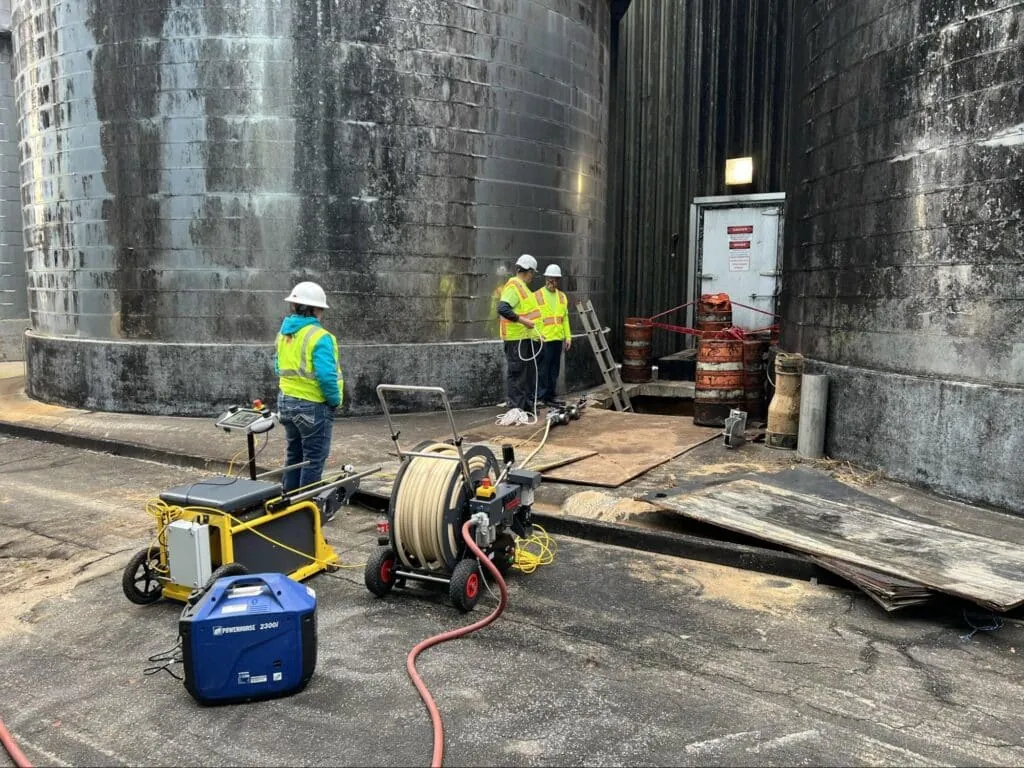
The dangers of a confined space in a sewer come from the atmosphere, not just the tight quarters. Toxic gas, oxygen displacement, flammable vapor, and engulfment can all be present in the same manhole, and several give no warning a worker can sense.
The hazards a sewer crew should expect below grade include:
- Hydrogen sulfide: produced by decomposing organic matter in sewage, hydrogen sulfide is immediately dangerous to life or health at 100 ppm, and a worker loses the ability to smell it between 100 and 150 ppm. Odor is never a reliable indicator of a safe atmosphere.
- Oxygen deficiency or enrichment: OSHA treats the atmosphere as hazardous below 19.5 percent oxygen or above 23.5 percent. Decomposition and rust can quietly consume oxygen in a closed manhole.
- Flammable gases: methane and other gases become a hazard above 10 percent of the lower flammable limit. A single spark or hot tool can then ignite the space.
- Engulfment: a surge of water or sludge from upstream can fill a manhole or wet well faster than a worker can climb out.
- Changing conditions: because the system stays live, the atmosphere can shift during the work, which is why monitoring has to be continuous rather than a one-time check.
The stakes are not theoretical. Federal data recorded 1,030 confined space fatalities from 2011 to 2018, the most recent confined-space-specific federal tally. Many of those deaths involved would-be rescuers who entered to save a downed coworker, which is exactly why non-entry rescue is the standard for sewer work.
Atmospheric hazards are only one piece of sewer-operation safety. High-pressure cleaning carries its own risks, which we cover in our safety procedures for sewer jetting operations.
Confined Space Entry Equipment for Sewer and Manhole Crews
Confined space entry equipment for sewer work falls into five categories: atmospheric monitoring, ventilation, retrieval, access and fall protection, and communication. Each category controls a specific hazard, and crews across municipal sewer, water, and wastewater operations should not enter without all five in working order.
The table below maps each hazard to the gear that controls it:
| Hazard | Equipment that controls it |
| Toxic or flammable gas, low or high oxygen | Four-gas monitor (oxygen, LEL, hydrogen sulfide, carbon monoxide) |
| Accumulated gas in a closed space | Powered ventilation blower with ducting |
| A worker down below grade | Tripod or davit with a winch and full-body harness |
| Falls during entry and exit | Harness, lifeline, and a secured ladder or access point |
| Loss of contact with the entrant | Two-way radio or hardwired communication system |
A closer look at what each piece does:
- Four-gas monitor: can help a crew detect the gases that have no reliable odor, and it should be bump-tested before each use and calibrated on the manufacturer’s schedule.
- Ventilation blower: designed to push fresh air into the space and clear accumulated gas before and during entry.
- Tripod or davit: anchors the retrieval winch over the opening. A mechanical retrieval device is required for vertical permit spaces deeper than 5 feet, which covers most manholes.
- Full-body harness and lifeline: connects the entrant to the retrieval system so the attendant can pull them out without entering the space.
- Communication system: keeps the attendant in constant contact with the entrant, so a problem below grade is caught immediately.
Brown Equipment Company has equipped municipal and contractor crews across its six-state Midwest service area since 1968. Its work-zone and communication safety systems help keep an attendant in contact with an entrant and the area around an open manhole controlled, and its maintenance and repair services help keep a crew’s equipment dependable across any brand or model. A monitor that reads wrong is worse than no monitor, so inspect and maintain every piece of entry gear on the manufacturer’s schedule before it goes in the field.
How to Enter a Manhole Safely: A Step-by-Step Procedure
Entering a manhole safely follows a fixed sequence: assess, permit, isolate, test, ventilate, set up retrieval, then monitor continuously. Skipping or reordering steps is how most confined space incidents begin.


- Assess the space and the work. Confirm the manhole is permit-required and identify every hazard before anyone approaches the opening.
- Issue the entry permit. Document the hazards, the controls, and the assigned entrant, attendant, and supervisor.
- Isolate what you can. Block or divert flow where the system allows, and lock out any connected mechanical or electrical energy.
- Test the atmosphere from the top down. Measure oxygen, flammable gas, and toxic gas at the top, middle, and bottom of the space before entry, since gases stratify by weight.
- Ventilate before and during entry. Run a blower to clear the space and continuously refresh the air while work is underway.
- Set up retrieval and the attendant. Position the tripod or davit, connect the entrant’s harness to the winch, and confirm the attendant has communication and stays outside.
- Monitor continuously and plan for non-entry rescue. Keep the gas monitor running throughout the work. If a worker goes down, perform a non-entry rescue with the retrieval system rather than entering after them.
Can Remote Inspection Reduce Confined Space Entries?
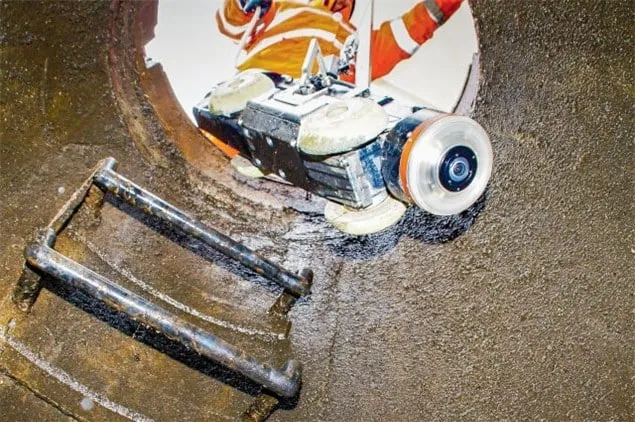
Yes. The safest confined space entry is the one a crew never has to make. Remote camera inspection lets crews assess pipe and structure condition from the surface, which can reduce how often anyone needs to go below grade.
Several inspection methods let crews evaluate lines and manholes without going below grade:
- Push cameras: feed a camera on a flexible rod into smaller lines and laterals from the surface.
- Crawlers: drive a camera through mainlines to inspect longer runs in detail.
- Pole cameras: drop a camera into a manhole to assess the structure before anyone considers entering.
Pairing these tools with a proactive CCTV inspection program helps a crew prioritize which structures actually require a person inside, and professional camera inspection and repair services keep that equipment ready when it is needed. Because inspection gear only protects crews when it works, routine sewer camera maintenance keeps the avoid-entry option open.
Frequently Asked Questions About Confined Space Entry in Sewers
What equipment is needed for sewer entry?
A sewer crew needs five categories of confined space equipment: a four-gas monitor, a ventilation blower, a tripod or davit with a winch, a full-body harness and lifeline, and a communication system. All five should be in working order and tested before entry, since each one controls a different hazard.
What kind of gas detector is needed for confined space entry?
A four-gas monitor that reads oxygen, lower explosive limit (flammable gas), hydrogen sulfide, and carbon monoxide is the standard for sewer entry. It should be bump-tested before each use, because hydrogen sulfide deadens the sense of smell between 100 and 150 ppm and cannot be detected reliably by odor.
Is a manhole always a permit-required confined space?
In practice, yes. A manhole connected to a live sewer cannot be fully isolated and can contain a hazardous atmosphere, so crews should treat it as permit-required by default. A space can be reclassified only after its hazards are eliminated and documented, which is rarely possible in an active sewer.
What is a tripod in confined space entry?
A tripod is a three-legged frame set over a manhole opening that holds a retrieval winch and the entrant’s lifeline. It lets an attendant raise a worker without entering the space, and OSHA requires a mechanical retrieval device for vertical permit spaces deeper than 5 feet.
Can you rescue a worker without entering the manhole?
Yes, and it is the preferred method. A non-entry rescue uses the retrieval winch and harness to pull a downed worker out from the surface. Entering after a collapsed coworker without proper equipment is how many confined space deaths happen, so the attendant stays outside and works the retrieval system instead.
Get the Right Confined Space Equipment for Your Crew
Manhole and sewer entries are unforgiving, and the right monitoring, ventilation, and retrieval gear is what keeps a routine job routine. To match equipment to the hazards your crews face, contact the Brown Equipment Company team to talk through your needs or schedule a free on-site demonstration.
Want help finding the right equipment?
Drop your name and number. A consultant will call you back, typically within one business day, to talk through what fits your operation.