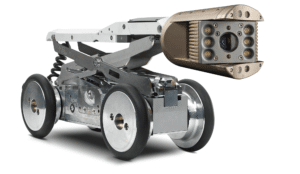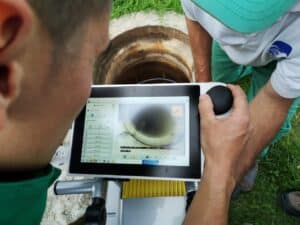
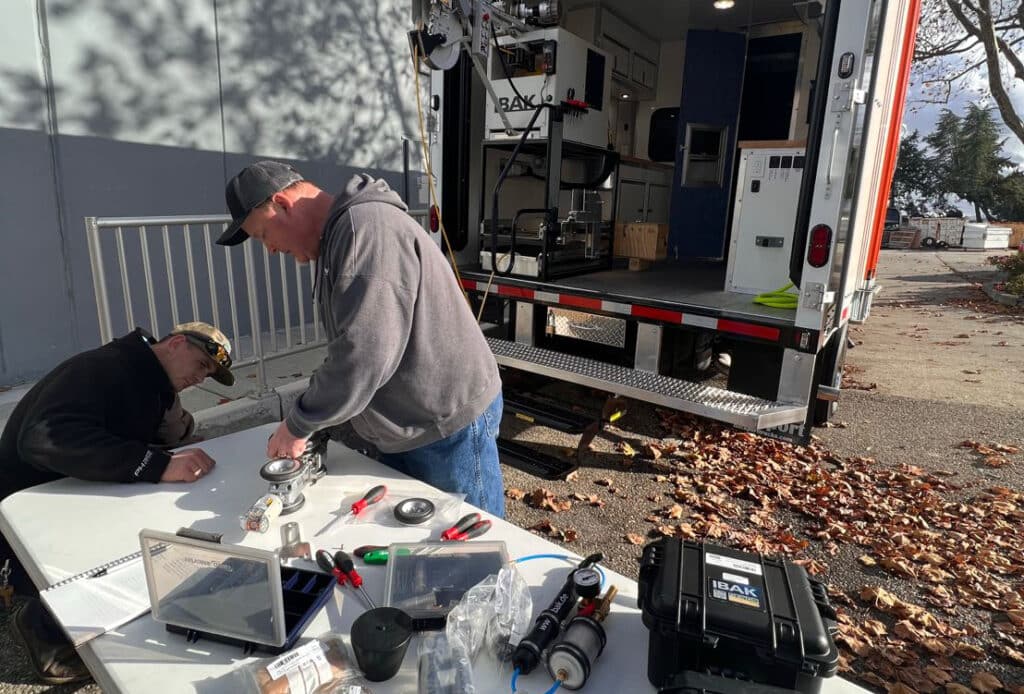
Sewer camera maintenance is the difference between a CCTV crawler that runs reliably for a decade and one that fails in the middle of a 500-foot inspection. The real question for most municipal crews and contractor fleets is what to service in-house, what to send out for professional repair, and when a unit has reached the end of its working life.
Key Takeaways
- Daily, weekly, and semi-annual maintenance cycles keep CCTV cameras out of the failure-and-replace cycle. A documented municipal practice combines end-of-day cleaning, weekly disassembly, and semi-annual leak testing to extend crawler service life past a decade.
- Mainline crawlers, lateral launch systems, push cameras, and pan-and-tilt heads each fail in different ways. Maintenance routines have to match the platform.
- Aging infrastructure is putting more pressure on inspection programs: the U.S. wastewater conveyance pipe network grew from 1.3 million miles in 2019 to 1.87 million miles by 2024, while collection system failures climbed from 2 to 3.3 per 100 miles of pipe.
- Most camera failures fall into four categories: seal and gasket degradation, cable damage, connector corrosion, and software or control unit faults.
- Repair when costs run under roughly half of replacement value, downtime is acceptable, and the platform is still manufacturer-supported. Replace when repair costs approach the price of a new system, parts are unavailable, or the system no longer meets PACP standards.
- Poor maintenance shows up in NASSCO PACP coding accuracy: foggy optics, water-logged housings, and inconsistent lighting produce coding errors that propagate into capital planning decisions.
Why Sewer Camera Maintenance Matters More Than It Used To
CCTV inspection cameras work in one of the most punishing environments any piece of municipal equipment encounters. They are submerged in raw sewage, dragged through chemical-laden cleaning water, scraped against pipe defects, and asked to deliver consistent video and accurate defect coding for hours at a time. Without disciplined maintenance, even high-end systems degrade fast. The pressure on inspection programs is increasing.
Don Hickman, a CCTV crew supervisor for the City of Raleigh DOT Stormwater Maintenance Unit, has framed the choice this way in published interviews: “We can either let the crawler deteriorate to the point of failure because of the harsh environment it works in, or we can be proactive and work to maintain our equipment in order to maximize our uptime.” Raleigh’s CCTV crew has reported inspecting 60,000 linear feet of pipe annually across more than 500 miles of stormwater infrastructure. That kind of utilization rewards discipline.
Daily, Weekly, and Semi-Annual Sewer Camera Maintenance Routine
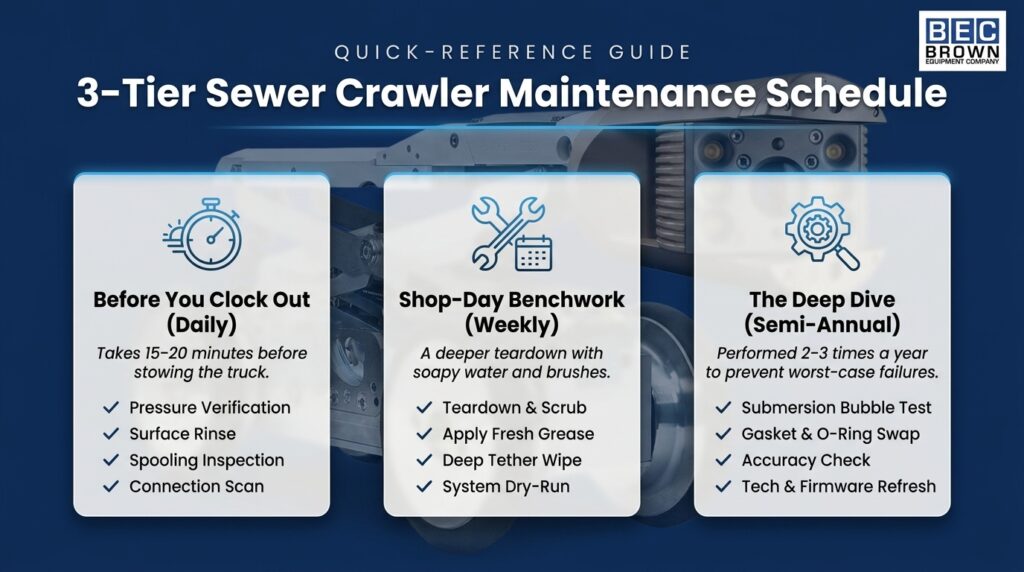
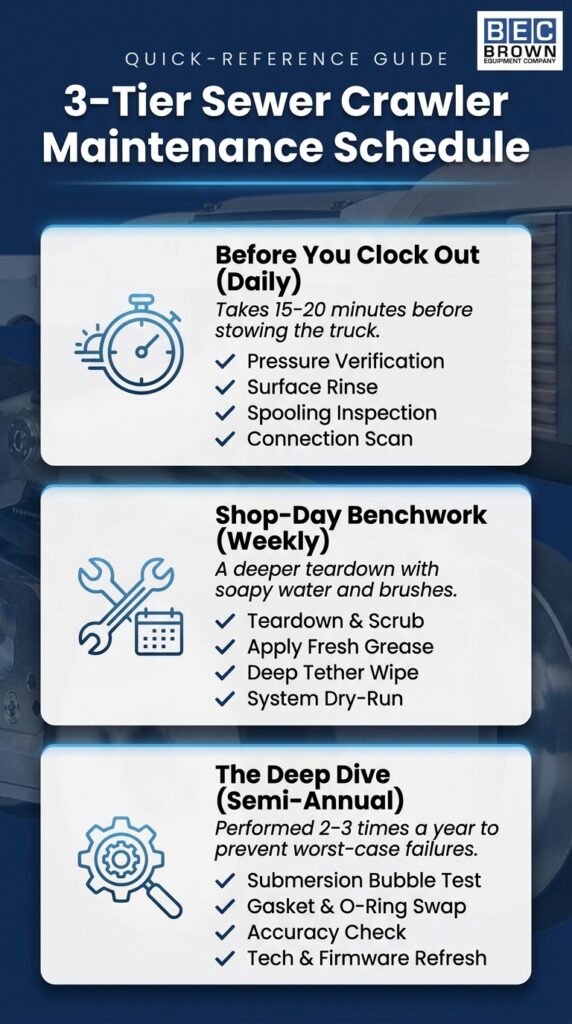
A sewer crawler preventive maintenance schedule has three layers: end-of-shift tasks, weekly shop-day tasks, and deep checks done two or three times a year. The cadence below reflects the practice that high-utilization municipal CCTV crews have documented as their standard, adjusted for current camera platforms.
Daily: End-of-Shift Tasks
Built into close-out, the daily sequence takes 15 to 20 minutes.
- System pressure check: Verify the housing is holding nitrogen or air pressure to spec before the unit goes back on the truck.
- Exterior wash-down: Rinse the crawler, camera head, and exposed cable to clear grit and any cleaning chemicals.
- Cable inspection during rewind: Watch the cable as it spools and flag any cuts, abrasions, or kinks.
- Connector check: Visually inspect every quick-disconnect and threaded connector for moisture, corrosion, or debris.
Weekly: Shop-Day Tasks
Once a week, ideally on a non-inspection day, the crawler comes apart for a full cleaning with soapy water, toothbrushes, and renewed lubrication.
- Disassemble and clean: Camera, lift, wheels, spacers, and screws come apart. Scrub, dry, and apply moisture-displacing lubricant to screw holes.
- Lubricate moving parts: Wheel bearings, lift mechanisms, and O-ring contact surfaces need fresh manufacturer-spec grease.
- Cable cleaning during full rewind: Run a clean rag along the cable as it spools. Grit is the leading cause of jacket abrasion.
- Functional test: Confirm lights, pan-and-tilt, and tractor controls before the unit goes back into service.
Semi-Annual: Deep Checks
Twice a year, the crawler should get a leak test that simulates worst-case water exposure.
- Submerged leak test: Submerge the crawler in soapy water under operating pressure and watch for bubbles at every seal, port, and connector.
- Seal replacement: Replace any O-ring or gasket that shows hardening, cracking, or compression set.
- Software and firmware update: Confirm the control unit, camera, and reporting software are on the current release.
- Calibration verification: Check pan-and-tilt centering, focus accuracy, and any measurement features. Our guide to advanced pipeline inspection cameras covers what calibration drift looks like.
Common Failure Modes by Camera Platform
Camera platforms fail in different ways. The comparison of push, crawler, and zoom inspection systems covers the platform differences from a selection standpoint. The breakdown below is what each platform tends to break.
Mainline Crawlers
- Wheel and drive failures: Most common cause of in-pipe stoppage. Worn tires, debris-fouled bearings, and broken drive shafts come from the abrasive environment.
- Sealed housing leaks: Seal degradation from chemicals, pressure cycling, and impact. Almost always preventable with the semi-annual leak test.
- Lift mechanism wear: On adjustable-height crawlers, the lift assembly is exposed to grit and shows the most mechanical wear.
Lateral Launch Systems
- Push rod fatigue: The tube driving the lateral camera into the line takes the most stress. Look for kinks, deformation, or cracking at the launch point.
- Launch mechanism wear: Mechanically complex and accumulates wear faster than the mainline tractor it rides on.
- Lateral camera head damage: Smaller and more exposed than mainline heads. Replace gaskets at the first sign of moisture.
Push Cameras
- Push rod jacket damage: The semi-rigid rod is the wear item. Cuts, kinks, and jacket separation make it unreliable.
- Camera head impact damage: Push heads take direct impact at every offset and obstruction. Optical glass and front bezel go first.
- Slip ring wear: Electrical noise, intermittent video, or signal dropouts on a powered reel usually trace to a worn slip ring.
Pan-and-Tilt Camera Heads
- Mechanism failure: Stiffness, jerky motion, or off-center homing all point to gear-train or position-sensor wear.
- Optical fogging: A slow drop in image clarity over weeks usually means a compromised seal letting moisture into the optical chamber.
- LED lighting degradation: LEDs dim with use. Underexposed footage on standard settings is often a lighting issue, not a camera issue.
How Chemical Exposure Damages Sewer Camera Seals
Chemicals used in pipe cleaning are the single biggest non-mechanical threat to camera seals and gaskets. Hydrogen peroxide, sodium hydroxide, and proprietary degreasers all attack rubber compounds over time. Even neutral pH cleaners cause swelling and softening if seals sit in residual chemical between flushes.
The practical defense is sequencing and rinsing. Cameras should not be deployed into a line that was chemically treated within the last working shift, and crews should rinse the camera with clean water immediately after any inspection that includes residual cleaner. Heavy chemical cleaning programs should plan to replace primary seals on a fixed schedule rather than waiting for failure. The OEM parts inventory at Brown Equipment Company stocks replacement seals, gaskets, and connectors for the camera platforms it sells and services.
When to Repair, Recondition, or Replace a Sewer Inspection Camera
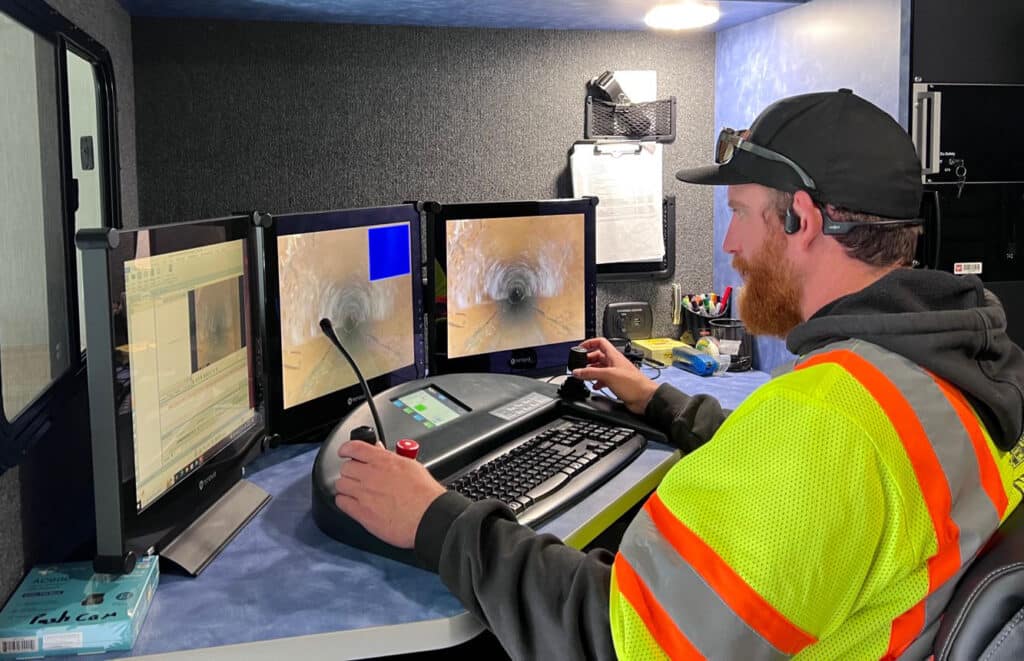
The repair-vs-replace decision is where most inspection programs lose money. Crews repair systems that should have been retired, or replace systems that had years left in them. The framework below gives a defensible decision in five questions.
- Repair quote as a percentage of replacement cost? Under 30%, repair almost always wins. From 30% to 50%, repair is usually right if the rest of the system is in good shape. Above 50%, replacement deserves serious consideration.
- How old is the camera platform? Service life scales with utilization. A high-utilization municipal crawler in continuous service for many years is closer to retirement than a low-mileage contractor system of the same age.
- Is the platform still manufacturer-supported? Once OEM parts and software updates stop, the system is on borrowed time. Confirm support status before committing to a major repair.
- Does the system still meet your reporting standards? If the camera cannot deliver the resolution, lighting, or pan-and-tilt control needed for current PACP, LACP, or MACP coding, repair only delays the inevitable.
- What is the downtime cost during repair? A short bench repair on a backup unit is a different decision than a four-week repair on the only crawler in the fleet. Factor lost footage and contract penalties in.
A middle path that is often overlooked is reconditioning. The reconditioning service at Brown Equipment Company handles disassembly, component replacement, and reassembly for camera carrier vehicles. For a crawler that is mechanically tired but still meets reporting standards, reconditioning the carrier vehicle while the camera platform is repaired or upgraded can extend the useful life of the full system. The same logic plays out across the broader fleet, as covered in our repair vs. replacement framework for heavy equipment. If a camera does cross into replacement, our guide to selecting sewer video inspection equipment covers the platform decisions worth making before signing a purchase order.
How Maintenance Affects NASSCO PACP Data Integrity
Sewer camera maintenance is not just an equipment uptime issue. It is a data integrity issue. NASSCO Pipeline Assessment Certification Program (PACP) coding depends on consistent video quality, accurate distance counting, and reliable lighting. Every one of those degrades when a camera is poorly maintained.
Foggy optics from a compromised seal cause coders to miss hairline cracks and root intrusions. Inconsistent LED output makes severity grading unreliable from one inspection to the next. Distance counter slip from a worn cable reel produces defect locations off by feet, sometimes tens of feet, in capital planning maps. The proactive CCTV inspection strategy depends on the data being trustworthy. Loose maintenance produces loose data.
How Brown Equipment Company Supports Sewer Inspection Camera Maintenance and Repair
The camera services group at Brown Equipment Company specializes in IBAK pipeline inspection equipment, including mainline crawlers, lateral launch systems, pan-and-tilt heads, push cameras, and control units. Camera service work is performed by factory-trained technicians using OEM parts. The full set of RapidView IBAK inspection systems supported by Brown Equipment Company includes the mainline cameras, crawlers, cable reels, and control units that make up the bulk of municipal CCTV fleets in the Midwest.
For broader fleet support, the maintenance and repairs service line covers any brand or model of heavy equipment, regardless of where the equipment was purchased originally. When a camera failure shows up in the field and downtime is the priority, the repair request form routes the request directly to the service team.
Frequently Asked Questions About Sewer Camera Maintenance
How often should a sewer crawler be cleaned and serviced?
A sewer crawler should be wiped down and pressure-checked at the end of every shift, fully disassembled and cleaned weekly, and leak-tested twice a year. This daily/weekly/semi-annual rhythm is the practitioner standard most fleet managers benchmark against, documented by high-utilization municipal CCTV programs. High-utilization shops sometimes shorten the semi-annual cycle to quarterly.
What are the most common reasons a sewer inspection camera fails?
Seal and gasket failure is the most common root cause across all camera platforms, followed by cable damage, connector corrosion, and pan-and-tilt mechanism wear. Most of these failures are preventable with disciplined daily and weekly maintenance, and most are repairable when they do occur.
How do I know whether to repair a damaged camera or replace it?
Compare the repair quote to replacement cost, factor in platform age, manufacturer support status, and whether the system still meets your PACP reporting standards. Repairs under roughly 30% of replacement cost almost always make sense. Repairs above 50% deserve hard scrutiny against a new-system quote. Reconditioning the carrier vehicle is often a useful middle path.
Can a damaged camera cable be re-terminated, or does the whole reel need replacement?
Most professional sewer inspection camera repair programs can re-terminate a damaged cable end, replace a section of jacket, or splice a new connector onto a healthy cable. Full reel replacement is usually only needed when the cable has multiple internal conductor breaks or when water has migrated up the cable into the reel.
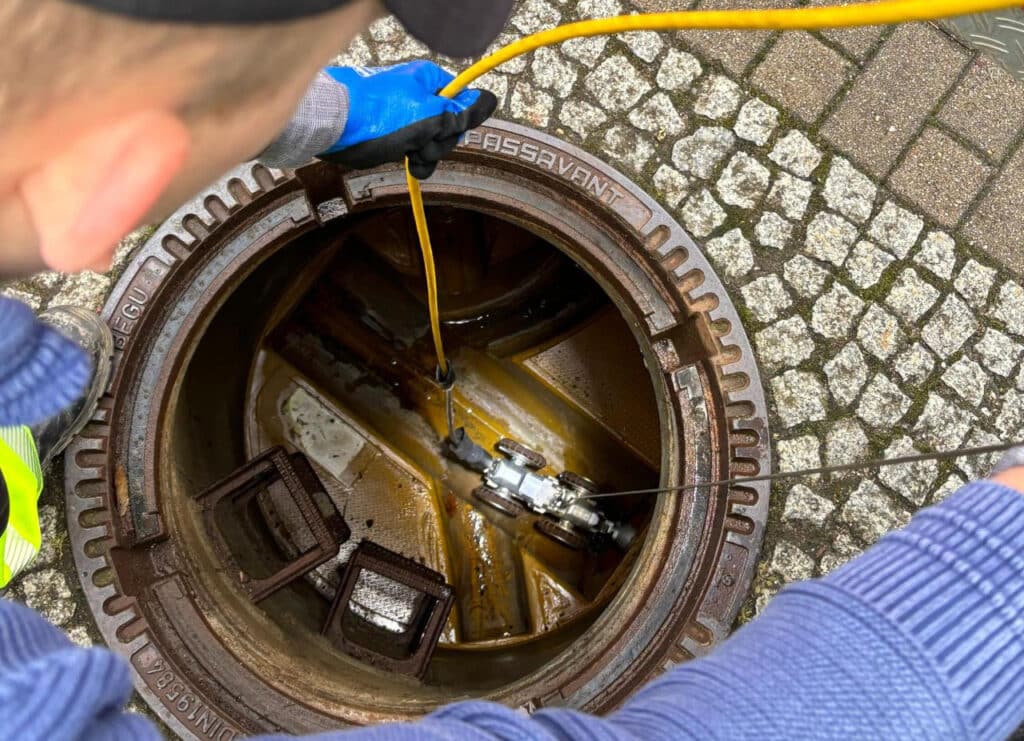
Keep Your Inspection Cameras in the Field
Strong sewer camera maintenance protects two things at once: the equipment investment and the integrity of the inspection data the equipment produces. If your crew is rebuilding a maintenance routine, deciding between repair and replacement on a tired system, or working through a specific camera failure, reach out to the Brown Equipment Company team to talk through the right next step.