Street sweeper operator training is one of the most underbuilt programs in public works and municipal fleet management. Most operators receive a brief orientation, then go out on their own — and the gaps in that approach show up as equipment damage, safety incidents, and inconsistent performance on the street. This guide outlines what a structured, comprehensive street sweeper operator training program actually looks like, from day-one onboarding through ongoing skill development and compliance documentation.
Key Takeaways
- No operator should work independently without at least 40 hours of supervised training — an industry standard cited by experienced fleet managers in the sweeping industry.
- Federal regulation 49 CFR 383.91 requires a CDL for vehicles over 26,000 lbs. CDL operators must also complete documented pre-shift inspections under 49 CFR 396.11.
- Training must be model-specific. Operators certified on a mechanical sweeper are not automatically qualified on a regenerative-air or vacuum sweeper — the controls, systems, and operational demands differ significantly.
- NAPSA’s Certified Sweeper Operator (CSO) program covers 14 training modules and provides a nationally recognized certification standard for municipal and contractor fleets.
- Documentation matters as much as training itself. Signed training records protect the organization in the event of an accident and create accountability for skill verification.
- Dealer-led training events are a practical supplement to in-house programs — especially when onboarding operators to equipment with model-specific features and safety systems.
Why Training Gaps Are Costing Your Fleet
Inadequate operator training is a direct driver of equipment damage, safety incidents, and increased total cost of ownership. Street sweepers operate in demanding environments: low speeds, tight curb proximity, high dust and debris exposure, and heavy urban traffic. That combination creates significant risk when operators aren’t properly prepared.
According to the Bureau of Labor Statistics’ Census of Fatal Occupational Injuries, transportation incidents account for 38.2% of all occupational fatalities — making them the single most common cause of workplace death. For sweeper operators working at 2–4 mph in traffic, with limited visibility and a full hopper affecting stopping distance, the margin for error is smaller than most people assume.
A full hopper handles significantly differently than an empty one. Operators trained only on empty or lightly loaded equipment may be unprepared for the braking behavior changes that come with a loaded machine. Formal training programs address these dynamics directly.
CDL Requirements and Compliance Basics
The first question for any fleet manager building a training program is compliance: which operators need a Commercial Driver’s License, and what does that require?
Under 49 CFR 383.91 (OSHA/DOT), any vehicle with a gross vehicle weight rating over 26,000 lbs requires a CDL to operate. Many street sweepers — particularly truck-mounted models — exceed that threshold. CDL operators are also required under 49 CFR 396.11 to complete and document pre-shift vehicle inspections, creating a compliance record with each shift.
Not all sweepers require a CDL. Some compact and self-propelled models fall below the 26,000 lb threshold and don’t trigger the CDL requirement. Fleets with mixed equipment — some requiring a CDL, some not — need to build separate training tracks that reflect those differences. A single one-size-fits-all orientation program doesn’t hold up when the equipment varies.
Building a Structured Onboarding Program
A structured onboarding program sets the foundation for everything that follows. Experienced contractors and municipalities consistently point to the same benchmark: no operator should work independently without at least 40 hours of supervised training. That number comes from direct field experience with new operator performance and risk, not from a regulatory minimum.
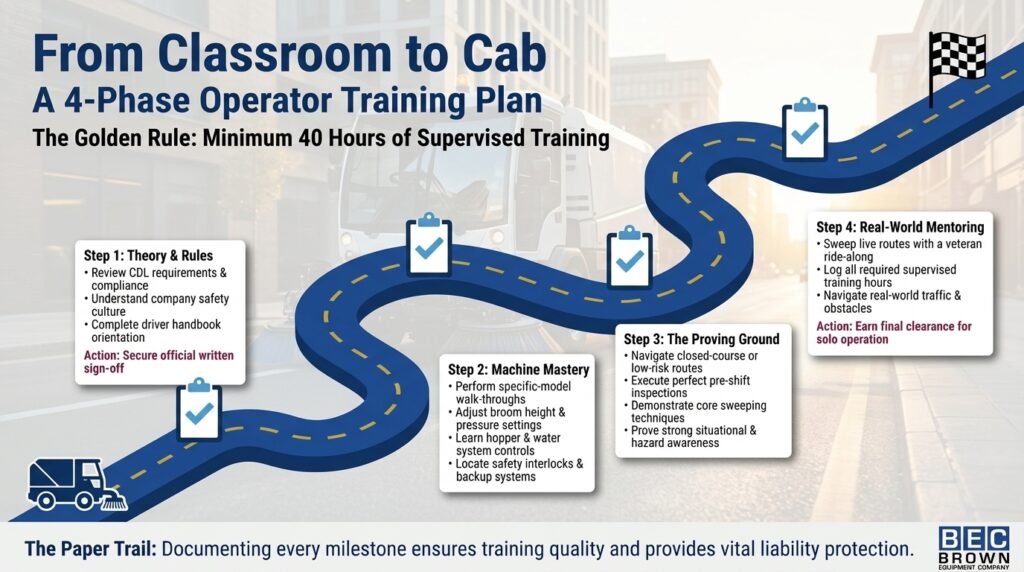
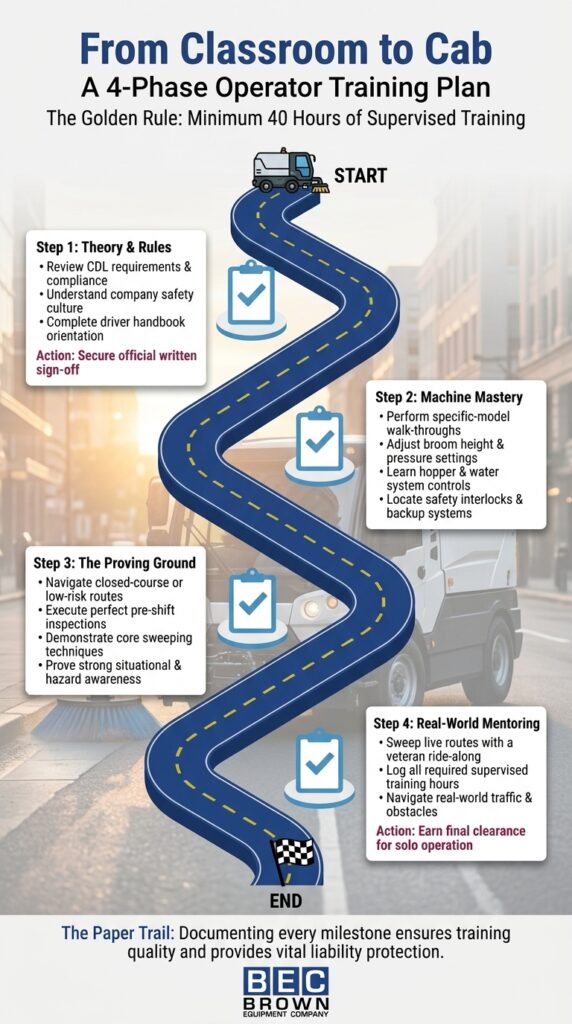
A practical onboarding sequence typically includes the following phases:
- Classroom or written orientation: CDL compliance requirements, regulatory overview, company policies, and safety culture. This phase includes a formal driver handbook review and operator sign-off.
- Equipment familiarization: Walk-through of the specific sweeper model the operator will run — controls, water system, broom height and pressure adjustments, hopper operation, safety interlocks, and backup systems.
- Supervised on-site operation: Operator drives and works the machine under direct observation on a low-risk route or closed course. The supervisor evaluates technique, pre-shift inspection performance, and situational awareness before advancing to independent operation.
- Supervised field operation: Operator works assigned routes with a supervisor or experienced operator riding along. Hours are logged, and sign-off is required before the operator goes out alone.
Documentation at each phase creates a clear record of what the operator learned, who verified it, and when. That record is both a training management tool and a liability protection document.
Model-Specific Training: Why One Program Isn’t Enough
Operators trained on one sweeper type aren’t automatically qualified on another. Mechanical, regenerative-air, and vacuum sweepers each have different controls, dust suppression systems, broom configurations, and operational behaviors. Training needs to reflect those differences.
Key areas where model-specific training matters most:
- Broom and brush systems: Mechanical sweepers use different adjustment techniques than regenerative-air units. Incorrect broom pressure is one of the most common causes of premature wear.
- Water and dust suppression: Each model has its own water system controls. Operators who don’t understand the system will either overuse water (creating mess and waste) or underuse it (creating dust violations).
- Hopper loading and dumping: Hopper capacity, load limits, and dump cycle operation vary by model. An operator unfamiliar with a specific model’s hopper may damage the machine or create a safety hazard during dumping.
- Safety interlocks and warning systems: Every model has its own set of interlocks and alerts. Operators must know what each warning means and how to respond.
Fleets running multiple sweeper types — which is common among municipalities and contractors managing diverse roadway operations — should maintain separate certification records by model, not just a single “sweeper operator” designation.
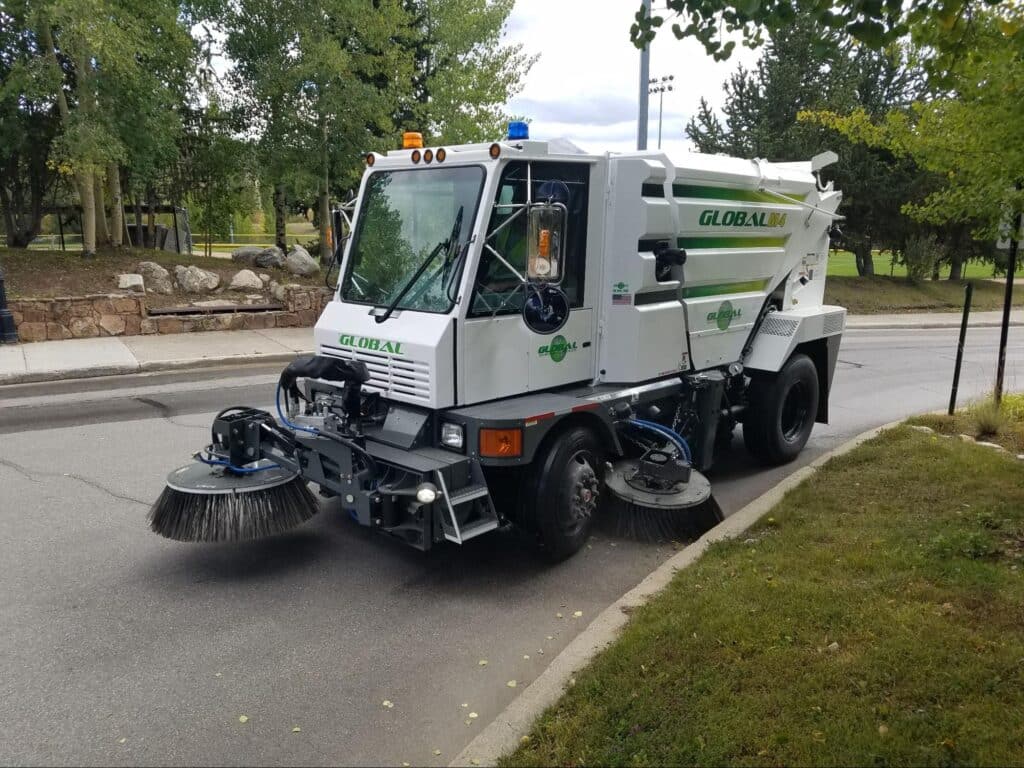
See how the Global M3 is configured and what operators need to understand about its controls and systems before taking it out on a route.
Pre-Shift Inspection: The Daily Accountability Check
Pre-shift inspections are both a regulatory requirement for CDL operators and the single best early-warning system for equipment problems. Operators who conduct thorough inspections catch issues before they become costly maintenance and repair events. Operators who skip or rush them do not.
A complete pre-shift inspection should cover at minimum:
- Tire pressure and tread condition
- Brake operation and fluid levels
- All lights, including work lights and backup alarm
- Mirror adjustment and rear visibility
- Water system readiness and water level
- Fire extinguisher presence and accessibility
- Undercarriage for debris buildup that could cause heat or mechanical problems
- All safety switches and interlocks
Training programs should include a standardized pre-shift inspection form — specific to each sweeper model — that operators complete and sign before every shift. That signed form becomes the compliance record required under 49 CFR 396.11 for CDL operations and a useful maintenance history for the service team.
Certification and Ongoing Development
Initial onboarding is the floor, not the ceiling. Ongoing training keeps skills current, introduces operators to new equipment or procedures, and builds a culture of operational accountability.
For fleets looking for a nationally recognized benchmark, the NAPSA Certified Sweeper Operator (CSO) program provides structured certification across 14 training modules. Topics covered include safe driving, sweeper basics, job maintenance, dust and noise management, post-accident procedures, and professional ethics. CSO certification provides a documented, third-party verification of operator competency that carries weight with insurers and oversight agencies.
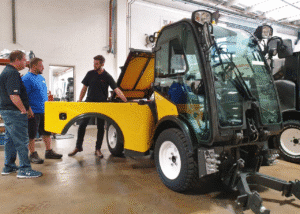
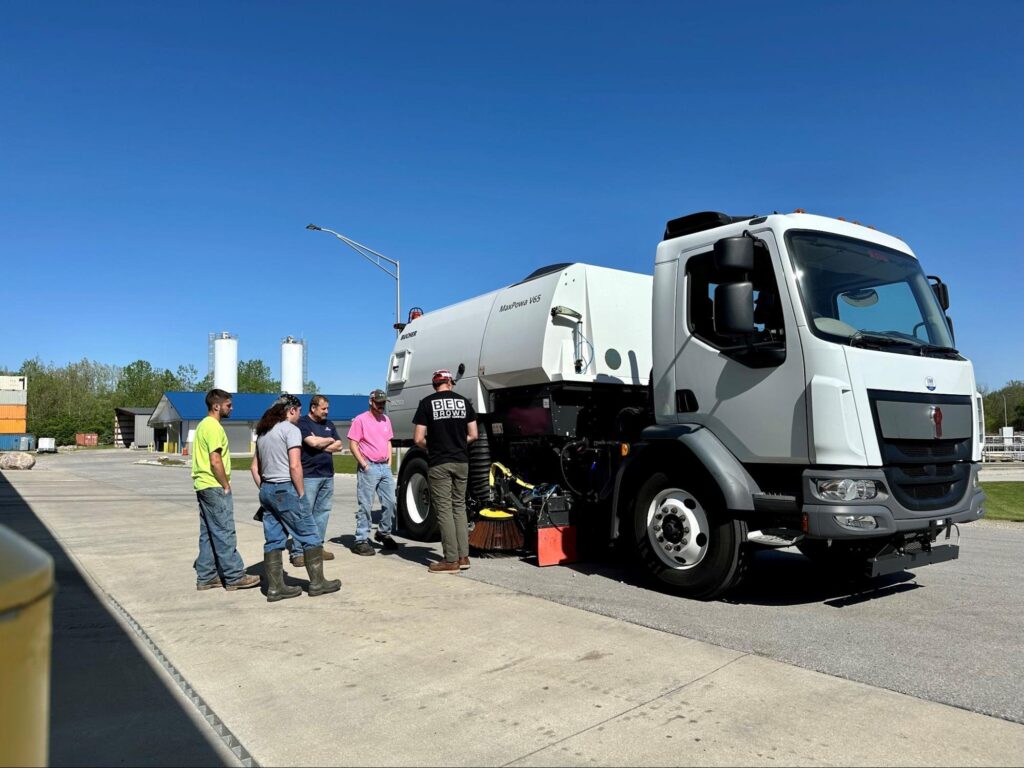
Dealer-led training events are another practical resource. Brown Equipment Company hosts Service and operator training events in partnership with Global Environmental Products — hands-on training programs focused on specific sweeper models. For fleets that have recently acquired new equipment or are adding new operators, these events provide model-specific instruction from people who know the machines in depth. Pair dealer-led events with your in-house documentation system and you have both the technical depth and the accountability trail that a complete training program requires.
Documentation: The Part Most Programs Skip
Training without documentation is training without accountability. If an operator is involved in an accident and the organization can’t demonstrate that proper training was completed, the liability exposure is significant.
A complete training documentation system includes:
- Signed acknowledgment of the driver handbook and company safety policies
- Signed completion records for each phase of onboarding (classroom, equipment familiarization, supervised field hours)
- Model-specific certification records that identify which sweepers each operator is qualified to run
- Ongoing training records for refreshers, new model introductions, or post-incident retraining
- Pre-shift inspection logs, retained by shift and by operator
These records should be stored in a central, organized system — whether a digital fleet management platform or a physical binder per operator. When an auditor, a supervisor, or an attorney asks what training a specific operator received before a specific incident, the answer should be immediately accessible.
Frequently Asked Questions About Street Sweeper Operator Training
What license do you need to operate a street sweeper?
It depends on the equipment. Street sweepers with a gross vehicle weight rating over 26,000 lbs require a Commercial Driver’s License (CDL) under federal regulation 49 CFR 383.91. Some compact or self-propelled sweeper models fall below this threshold and do not require a CDL, though safe operating training is still required regardless of licensing category. Fleets with both CDL-required and non-CDL equipment should maintain separate training tracks for each.
What should a street sweeper pre-trip inspection include?
A thorough pre-trip inspection covers tires, brakes, all lights and backup alarm, mirror condition, water system readiness, fire extinguisher, undercarriage for debris buildup, and all safety switches and interlocks. CDL operators are federally required to complete and document this inspection before each shift under 49 CFR 396.11. Non-CDL operators should follow the same checklist as a maintenance and safety best practice — and sign the form.
How long does it take to train a street sweeper operator?
Industry practice points to a minimum of 40 supervised hours before an operator works independently. That time covers classroom orientation, equipment familiarization, and observed field operation. New operators running a model they haven’t previously operated should complete model-specific familiarization on top of their baseline training, even if they are experienced sweeper operators generally.
What is the NAPSA Certified Sweeper Operator program?
The NAPSA Certified Sweeper Operator (CSO) program is a nationally recognized certification for professional sweeper operators. It covers 14 training modules across topics including safe driving, sweeper operation basics, dust and noise management, post-accident procedures, and ethics. CSO certification provides a documented, third-party record of operator competency. Details are available through the North American Power Sweeping Association.
My operators are experienced — does formal training still apply?
Yes, particularly when operators are transitioning to a different sweeper model or type. Experienced operators bring valuable habits and situational awareness, but model-specific systems — broom controls, hopper operation, water systems, safety interlocks — vary significantly across manufacturers and platforms. Skipping formal onboarding for experienced hires is one of the most common gaps in fleet training programs, and one of the most likely sources of equipment damage and near-miss incidents.
Build a Stronger Training Program with Brown Equipment Company Support
A well-structured training program reduces accidents, extends equipment life, and keeps your fleet compliant. It also gives you the documentation to demonstrate that your operators were properly trained — which matters when something goes wrong.
Brown Equipment Company supports operators and fleet managers across Indiana, Illinois, Kentucky, Ohio, Michigan, and Wisconsin with equipment sales, service and maintenance, and hands-on service and operator training events. If you’re building or improving your training program and want to discuss your fleet’s specific equipment needs, contact the Brown Equipment Company team to get started.