Switching from rock salt to liquid brine is a strategy decision that gets made in a budget meeting. Building the salt brine production system that supports it is a facility decision, and that part is where most planning conversations stall. Before any equipment quote makes sense, your shed needs the space, the power, the water, and the tank capacity to run a real anti-icing program through a full Midwest winter.
Key Takeaways
- A municipal salt brine production system is the brine maker, mixing and storage tanks, a truck fill station, and the controls that tie them together. The facility around them matters as much as the equipment itself.
- Plan footprint, electrical service, and water supply before selecting equipment. Design parameters vary by site, and FHWA guidance treats them as engineering decisions rather than off-the-shelf specs.
- Standard NaCl brine is 23.3 percent salt by weight, with a freezing point of -6 degrees F.
- Wisconsin field data across 143 storms showed brine-treated roads cleared more than two hours faster on average and used 23 percent less salt than rock-salt-treated routes.
- Wisconsin counties have reported $15,000 to $31,484 per year in maintenance costs covering brine maker, production and storage and loading system, and trucks. A practical planning ratio is roughly one brine truck per 100 lane miles served.
- Workflow integration, operator training, and a documented loading procedure are as important to program success as the brine maker itself.
What a Salt Brine Production System Actually Includes
A municipal salt brine production system is a connected set of components, not a single machine. At minimum it includes a brine maker that dissolves rock salt into water at a controlled concentration, a salinity or density sensor that holds the mix at the eutectic target, mixing and storage tanks, a truck fill station with a pump and meter, and the plumbing and controls that tie everything together. Some configurations add a secondary blending station for agricultural byproducts, beet juice, or calcium chloride for lower-temperature performance.
On the equipment side, the Brine Masters product line sold and serviced by Brown Equipment Company is a typical reference point for Midwest specifications. The Continuum series includes BM-3 brine makers rated up to 3,000 gallons per hour, BM-6 units up to 6,000 gallons per hour, truck fill stations in real-time blending, stack blending, and fixed-rate configurations, and a stand-alone SC-100 controller that brings older third-party equipment under modern automated salinity control.
Sizing the system to your operation is the first planning decision and sets every decision downstream. A small public works department running anti-icing on 80 lane miles needs a different production rate, tank storage, and fill station than a county DOT covering 600 lane miles with multiple shifts.
If your team is still weighing whether to convert at all, the trade-offs in the brine versus rock salt comparison for cities are worth working through first. This post assumes that decision is already made.
How Much Space Does a Brine Production Facility Need?
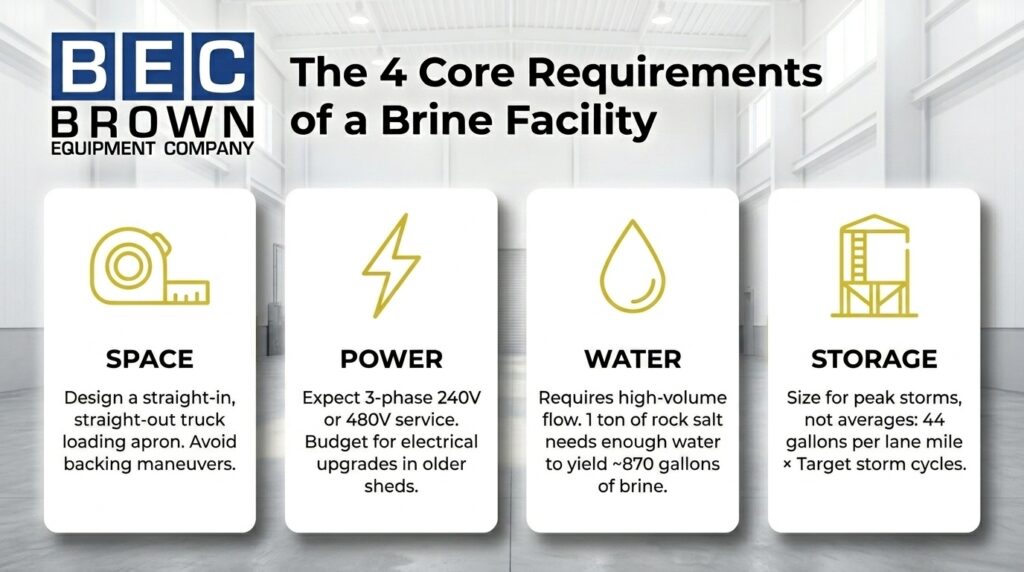
The footprint is driven by the brine maker, the tank storage, and the maneuvering room a tanker needs to dock and load. None of these is large in isolation. Together they often outgrow the corner of an existing salt shed where a department first imagines installing the system. A practical municipal layout organizes around the following zones:
- Brine maker pad: A level, drained slab sized to the unit’s footprint plus working clearance for salt loading, hose connections, and routine maintenance. Indoor placement protects controls from freeze cycles.
- Salt storage and conveyance: The brine maker needs a continuous supply of clean, dry rock salt. Most operations co-locate near the existing salt shed or use a dedicated salt bay with a hopper feed.
- Tank storage: A bank of vertical or horizontal storage tanks sized to peak storm consumption, with spacing for inspection and a containment area for spill management.
- Drainage and containment: A floor drain routed to a sump or an external curbed containment area prevents chloride runoff into stormwater systems during loading and maintenance spills.
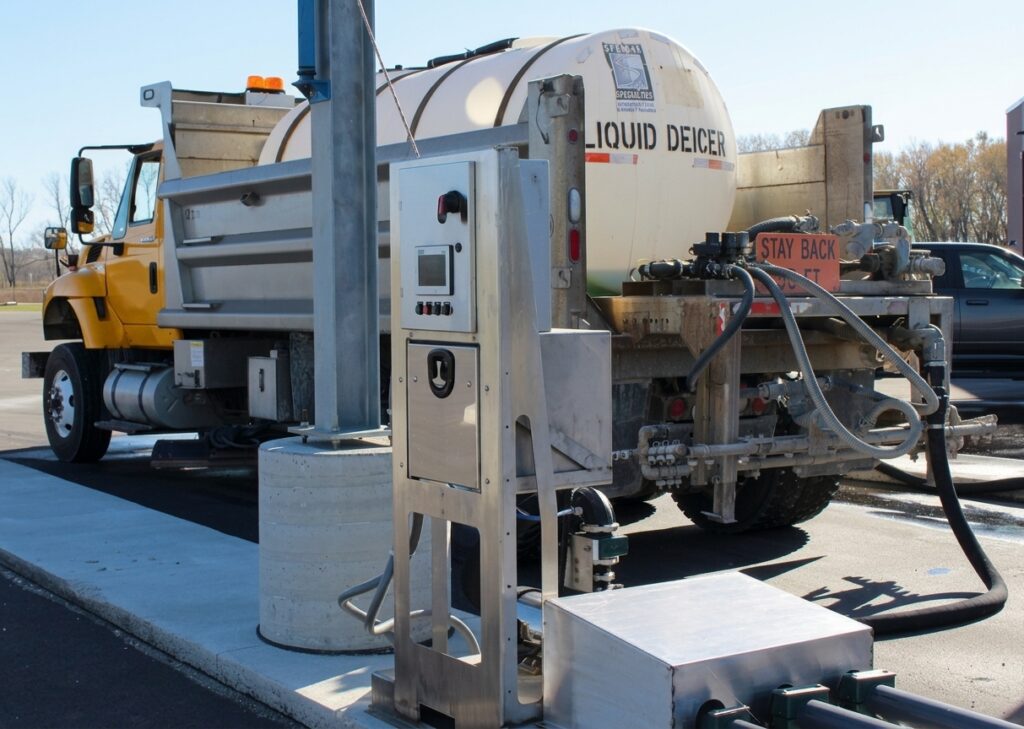
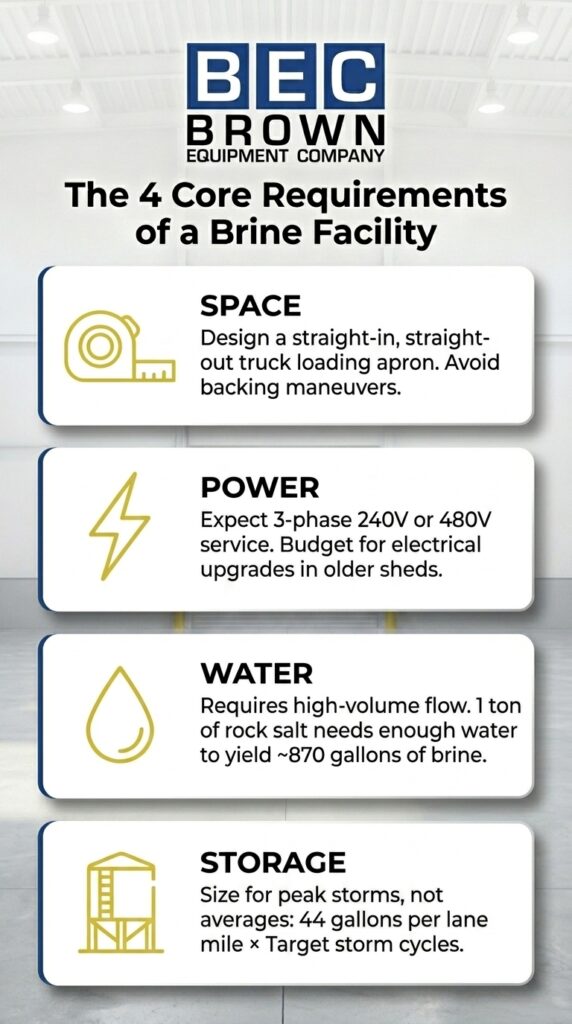
The truck fill apron is the zone most departments underestimate. A loaded brine tanker needs to pull straight in, dock, fill, and pull straight out, ideally without breaking the line of any plow or salt truck waiting for its own load. A layout that forces backing maneuvers in tight quarters at 3 a.m. will fight the operation every shift.
What Are the Power and Water Requirements for a Brine Production System?
Power and water are site-specific design parameters, not single industry-wide numbers. The Federal Highway Administration’s Manual of Practice for an Effective Anti-Icing Program treats facility design as a function of operation size, climate, and equipment selection. The right answer is a sizing exercise, not a default.
Electrical service
Brine makers, transfer pumps, fill station pumps, agitators, control panels, and heat trace on outdoor lines all draw from the facility’s electrical service. Most municipal-scale systems run on three-phase 240V or 480V service. Equipment manufacturers publish full-load amp draw for each component, and your electrical engineer will use those numbers to size the panel, conduit, and any service upgrades.
Two practical points worth raising early. Retrofit installations in older salt sheds frequently require a service upgrade. And controls and instrumentation tolerate temperature swings poorly, so heated indoor placement and conditioned panels pay back through the life of the system.
Water supply
Brine production is water-intensive. A practical rule of thumb is that one ton of rock salt produces approximately 870 gallons of brine at the standard 23.3 percent concentration. Your incoming water service has to keep pace with the brine maker. A 6,000 gallon-per-hour unit needs roughly 4,600 gallons per hour of incoming water during a production run.
Source options usually come down to municipal water with a backflow preventer, an on-site well, or a captured rainwater system with appropriate filtration. Each has cost and permitting implications. High-mineral water can scale equipment and affect salinity readings, so a softener is sometimes warranted depending on the source.
How Much Brine Storage Do You Need, and What Tanks Should You Use?
Storage capacity is the most common sizing mistake in new municipal brine programs. Departments size to last winter’s storm count, then run dry mid-event the first time a long-duration freezing rain hits. Build for peak consumption, not average.
Sizing the tank storage
Use the application rate, your treated lane miles, and a target run length to back into a minimum capacity. The Missouri DOT operator guide cites 44 gallons per lane mile as the standard pre-treatment rate. A department treating 300 lane miles per cycle needs roughly 13,200 gallons for a single application before any reserve.
A workable planning approach for new programs:
- Calculate gallons per pre-treatment cycle: lane miles times application rate.
- Multiply by the cycles you want to support without refilling. Two to three cycles is a practical reserve for a major event.
- Add capacity for any post-storm or pre-wetting applications running in parallel.
- Round up to the next tank size. Incremental storage is cheap relative to the cost of a stockout mid-storm.
On the production side, the Dutchess County brine cost-benefit analysis uses a planning ratio of approximately one brine truck per 100 lane miles served, a useful sanity check on whether your tank storage will keep the fleet supplied during a real storm.
Tank materials and configuration
Brine is corrosive. Standard tank materials are high-density polyethylene (HDPE), stainless steel, and fiberglass-reinforced plastic (FRP). HDPE is the most common municipal choice for cost reasons. Stainless is preferred for high-cycle production lines and outdoor installations where UV exposure is a concern.
Insulation matters at the upper salinity range. Brine held near the 23.3 percent eutectic concentration approaches its saturation point, and salt can recrystallize if the tank gets cold enough. Insulated tanks with polyurethane foam jacketing, heat trace on outdoor plumbing, and recirculation pumps are standard cold-climate practice. The eutectic point of NaCl brine at 23.3 percent by weight is a hard chemistry boundary, not a marketing claim. Indoor tanks cost more in floor space but are more forgiving in operation than outdoor tanks, which require more freeze protection.
How Does the Workflow Change Once You’re Running Liquid?
A brine production facility changes the rhythm of a public works yard. Plow trucks become anti-icing trucks during the pre-storm window, a brine tanker joins the active fleet, and the start-of-shift loading dance now includes a fill station instead of a single salt loader.
A typical municipal brine workflow looks like this:
- Forecast trigger: The decision to pre-treat is made off the National Weather Service forecast and the department’s anti-icing protocol, typically 24 to 48 hours ahead of frozen precipitation.
- Production run: Operators top off storage to anticipated peak demand, with the brine maker refilling tanks between cycles.
- Truck loading: Anti-icing trucks fill from the truck fill station with a metered quantity matched to their assigned routes.
- Application: Trucks pre-treat priority routes at the standard rate, with application data coming back through the controls or telematics system.
- Post-event: Tanks are inspected, lines flushed where needed, and salinity verified before production resumes for the next event.
Operator training is the part most planning conversations underweight. A salt truck driver and a brine truck driver are running different equipment with different application logic. Spreader settings, route timing, and application rates do not transfer one-for-one. Programs that treat training as a one-time orientation rather than an annual refresher tend to lose performance over time.
As Andrea Bill, Associate Director of the University of Wisconsin-Madison TOPS Lab, has put it: liquid brine is an effective tool, and along with training, education, and technology, storm fighters are making effective reductions in chloride on our roads. Training and technology are not the soft side of a brine program. They are what determines whether the equipment delivers the results the equipment promises.
Once the facility and workflow are in place, the operational practices that drive results, anti-icing timing, pre-wetting rates, and application calibration, are covered in detail in the Brown Equipment Company liquid brine systems winter readiness guide.
Building the Business Case Before You Build the Facility
A facility plan is easier to fund when the salt-reduction and service-level numbers are sitting next to it. Recent Midwest research is now strong enough that public works directors can quote field results from peer counties and DOT studies rather than relying on vendor estimates. Recent data points worth working into a council or commission presentation:
- Across 143 storms in 10 Wisconsin counties, brine-treated roads cleared more than two hours faster on average than rock-salt-treated routes, and used 23 percent less salt overall, per the UW-Madison TOPS Lab study.
- A peer-reviewed Wisconsin study published through ASCE found brine routes used 32.6 percent less salt per storm than solid-salt control routes, with no statistically significant difference in travel disruption.
- Follow-up Clear Roads research released by Wisconsin DOT in February 2026 found pre-wetted and brine applications used 40 to 72 percent less salt than dry application.
- Cary Institute summary work on chloride management cites estimates that pre-treatment programs can yield up to 75 percent salt savings, with the upper bound depending on storm conditions, training, and how aggressively a department converts to anti-icing as the default.
Cost figures from operating programs are equally usable. Wisconsin counties have reported $15,000 to $31,484 per year in maintenance costs covering the brine maker, production and storage and loading system, and trucks, and the corresponding benefit-cost analysis showed benefits outweighed investment. EPA reporting on winter road salt notes the broader corrosion cost is estimated at approximately $5 billion annually in the U.S., which puts the public-asset side of the case beyond just a fleet conversation.
Funding mechanisms are also broader than they were five years ago. State DOT cost-share agreements, federal infrastructure grants, and shared-facility models with neighboring municipalities can all defray initial capital. Two or three smaller departments splitting the cost of a single regional brine facility is a workable structure where direct municipal funding is not on the table.
For broader context on how a planning project like this fits into a larger winter and snow-and-ice strategy, the case for liquid brine generally is covered in the Brown Equipment Company overview of brine systems for snow and ice management.
Frequently Asked Questions About Salt Brine Production Planning
What size tank is needed for municipal brine storage?
Tank capacity should be sized to your peak pre-treatment cycle, not your average. Multiply your treated lane miles by 44 gallons per lane mile (the MoDOT-cited pre-treatment standard), then by the number of cycles you want to support without refilling, then add a reserve for parallel operations like pre-wetting. Most municipal programs land between 6,000 and 30,000 gallons of total storage depending on lane miles served.
What are the power requirements for a brine production system?
Power requirements are site-specific, not a single industry number. Most municipal-scale brine production runs on three-phase 240V or 480V service, with equipment manufacturers publishing full-load amp draw component by component. Older salt shed retrofits frequently require an electrical service upgrade, so plan for an electrical engineering review early.
Does a brine production system need a special water source?
It needs a high-volume, reasonably soft water source. Brine production at 6,000 gallons per hour requires roughly 4,600 gallons per hour of incoming water. Municipal water with a backflow preventer is the most common source. High-mineral water may require a softener to protect equipment and salinity readings.
Is it cheaper for a municipality to make its own salt brine than buy it?
Producing on-site is generally less expensive per gallon than purchasing pre-made brine, especially at municipal volumes. The economics improve as production volume rises and storage allows you to run the brine maker on a steady schedule. Run the full picture (equipment, facility, water, electrical, and maintenance over asset life) against a documented purchase quote before committing.
How long does it take to plan and install a municipal brine production facility?
Most municipal projects run six to twelve months from initial scoping to first production run. The longest-lead items are typically electrical service upgrades, site work, and equipment delivery. Departments that start the planning conversation in spring are usually positioned for fall commissioning.
Plan the Facility, Not Just the Equipment
A salt brine production system is a facility decision before it is an equipment decision. Brown Equipment Company works with public works directors and fleet managers across the Midwest to scope production capacity, storage sizing, electrical and water requirements, and workflow integration before any equipment quote goes on paper. To start a planning conversation for your operation, contact the Brown Equipment Company team.