Local agencies (counties, cities, and townships) are responsible for nearly half of all U.S. public road miles. Most of those miles run alongside vegetation that has to be cut, cleared, or controlled on a recurring schedule. For road department supervisors and public works directors, the hard question is no longer whether to mow. It’s what mix of roadside vegetation management equipment to own.
Key Takeaways
- Counties alone maintain over 1.5 million miles of U.S. public roads, more than any other ownership category. That makes equipment selection an operational decision, not just a procurement one (FHWA Highway Statistics 2023).
- Most public works fleets benefit from a mix of equipment categories: self-propelled boom carriers for line-of-sight roadside work, remote-controlled tool carriers for steep slopes and ditches, and multi-purpose carriers for crews that need year-round utilization.
- Match equipment to terrain, right-of-way geometry, crew size, and seasonal demand. A flat county with wide shoulders and a small crew has different needs than a hilly municipality with steep ditches and a year-round vegetation program.
- Operator safety is a fleet-design factor, not just a training topic. There were 226 fatal injuries among grounds maintenance workers in 2023 (BLS Census of Fatal Occupational Injuries), and remote-controlled and cab-protected equipment are designed to reduce exposure on the riskiest work.
- The Transportation Research Board’s NCHRP Research Report 1155 (2025) reframes roadside vegetation as an asset-management discipline. Equipment deployment is treated as a risk-informed strategic decision, not a fixed seasonal schedule.
- Working with a dealer that handles sales, rentals, demos, parts, and service helps fleets test combinations on their own terrain before committing capital, and keeps owned equipment running across its full service life.
What Counts as Roadside Vegetation Management Equipment?
Roadside vegetation management equipment refers to the powered machines, carriers, and attachments that public works crews use to cut, clear, mulch, or otherwise manage plant growth within a road right-of-way. The category includes self-propelled boom mowers, remote-controlled tracked carriers built for slopes too steep for an operator to ride, and multi-purpose tool carriers that swap between mowing, sweeping, and snow attachments across the year.
What separates this category from general grounds-care equipment is the operating environment: live traffic, uneven shoulders, drainage ditches, and slopes that flatbed tractors cannot safely operate on. The equipment that fits this work is purpose-built or purpose-attached for those conditions.
Why Fleet Composition Is an Operational Decision, Not Just a Purchase
Fleet composition used to look like a line item: replace the old boom mower, buy another flail attachment, lease a backup. That model is changing. The Transportation Research Board’s NCHRP Research Report 1155 (2025), produced for state DOTs, reframes roadside vegetation as an asset-management discipline. Equipment deployment becomes a risk-informed strategic decision based on data about where vegetation actually creates safety, drainage, or visibility problems, rather than a fixed mowing schedule applied uniformly across every mile.
For a county or municipal fleet, the practical translation is simple. The mix of equipment you own should reflect the mix of conditions you actually encounter, including:
- Steep ditch slopes that put a riding operator at rollover risk.
- Dense brush corridors that need flail or forestry-head capability, not just rotary cutting.
- Sightline triangles at intersections, where trimming is small-scale but high-frequency.
- Drainage easements that combine vegetation management with ditch maintenance.
- Routine shoulder mowing on long rural stretches, where throughput matters most.
A fleet built around three identical tractor-mounted side-arm mowers leaves crews underequipped for some of these conditions and overpays for others.
If your operation doesn’t yet have a documented vegetation strategy, building one is the prerequisite to a sound fleet decision. A 10-step strategic vegetation management plan can help your team scope the corridors, classify risk, and define service standards before you map equipment to roles.
The Core Equipment Categories for Roadside Vegetation Work
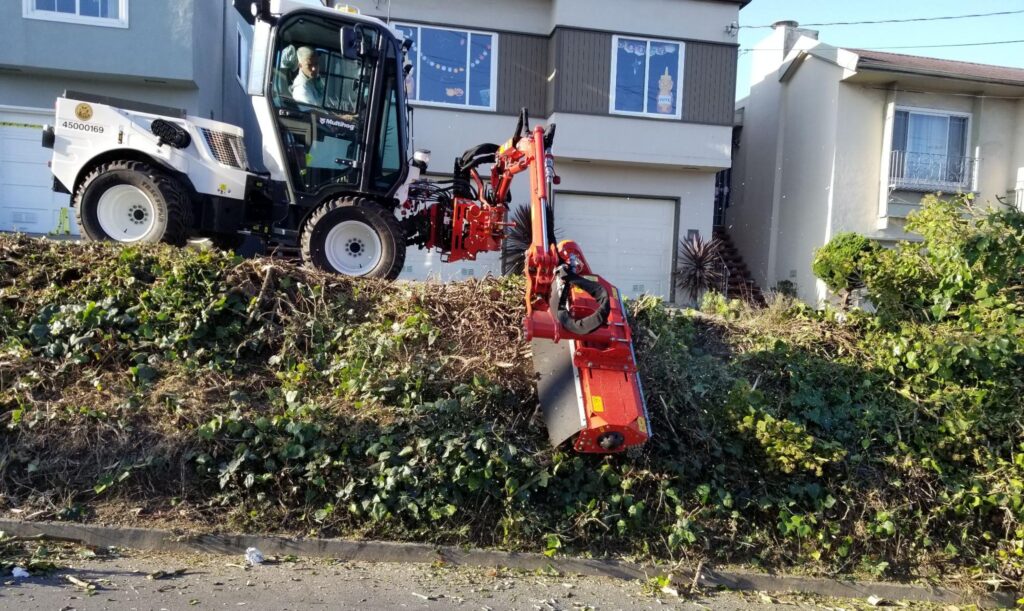
Roadside vegetation management equipment falls into a few well-defined categories. Most public works fleets end up with some combination of all of them, because each fills a role the others can’t. The decision is which categories to own outright, which to rent, and how the attachments line up across them.
Self-Propelled Boom Carriers
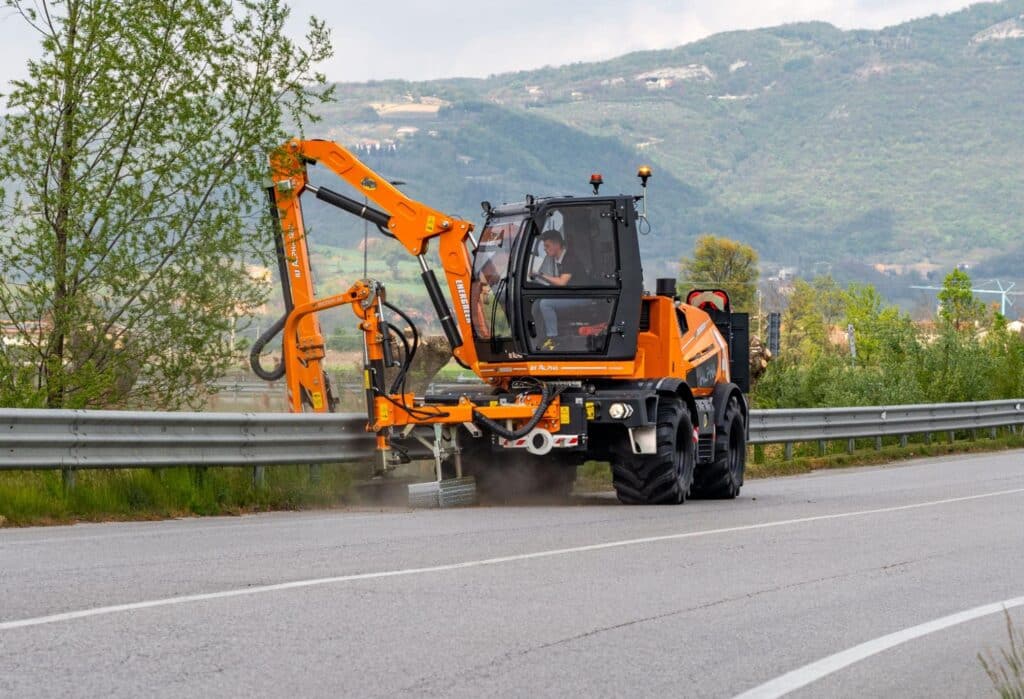
Self-propelled boom carriers are purpose-built machines designed around boom work. The operator sits in a protected cab while a hydraulic boom arm extends out over the shoulder, into the ditch, or up to elevated branches. These are the workhorses of large-volume shoulder and ditch mowing on county and state roads. Energreen ILF self-propelled hydrostatic machines are designed for professional roadside work with telescoping booms reaching up to 55 feet, multiple attachment options, and visibility-focused cabs.
Boom carriers fit fleets that move long distances between job sites, run vegetation crews year-round, and need single-operator productivity over wide rights-of-way. They are less suited to crews that work primarily on extreme slopes, where the operator’s position in the cab becomes a liability rather than an advantage.
Remote-Controlled Slope Mowers and Tool Carriers
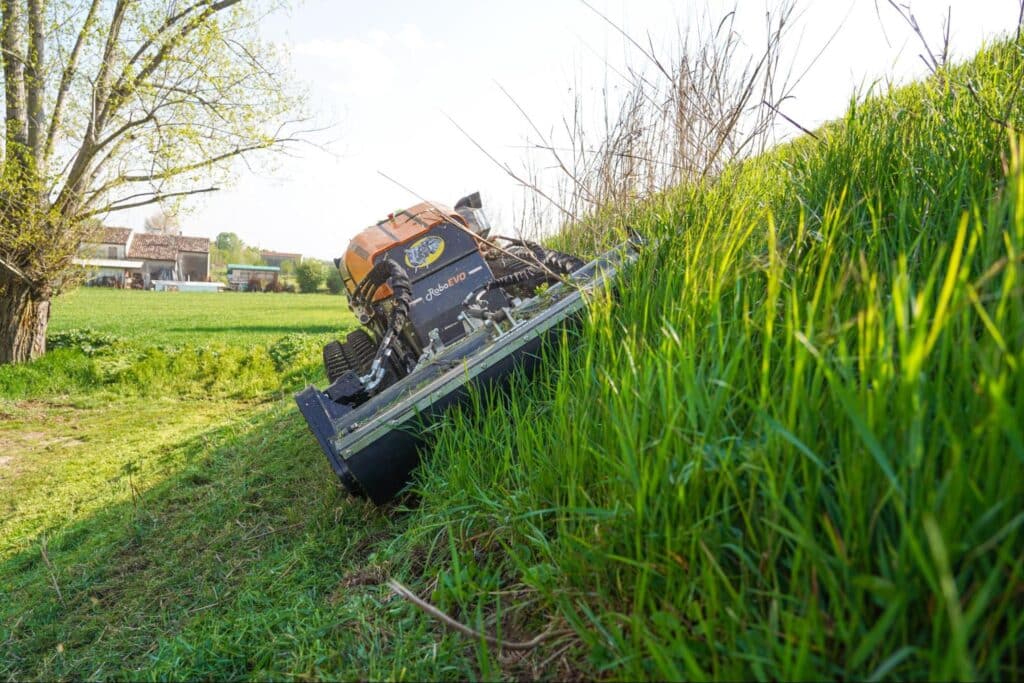
Remote-controlled tracked tool carriers are designed for slopes, ditches, and embankments that put a riding operator at risk of rollover, slip-off, or contact with traffic. The operator stands at a safe distance and runs the machine via radio control. Energreen Robo carriers, available through Brown Equipment Company, can work on slopes well beyond what a riding tractor can safely handle, and accept attachments ranging from rotary cutters to forestry heads to brush flails. The case for this category is largely safety-driven, and we cover it in detail in our comparison of remote-controlled slope mowers versus traditional mowing.
Beyond steep terrain, remote-controlled carriers also help with vegetation work near live traffic where a cab-based machine would put the operator close to the lane edge. The trade-off is throughput. They cover acres more slowly than a boom carrier, and they’re not the right tool for long shoulder runs on flat ground.
Multi-Purpose Tool Carriers
Multi-purpose tool carriers are articulated, road-legal machines built to accept multiple attachments and move under their own power between job sites. Multihog tool carriers, sold through Brown Equipment Company, accept rotary mowers, flail mowers, sweepers, salt spreaders, snow plows, pressure washers, and more, with a quick-change system designed for single-operator swaps in the field.
For smaller municipalities, public works departments with mixed seasonal duties, and any fleet that struggles to justify multiple single-purpose machines that sit idle for months at a time, this category often makes the math work. One carrier can mow vegetation in summer, sweep in fall, plow snow in winter, and handle pressure-washing duty in spring.
Specialized Boom and Carrier Attachments
Attachments aren’t a separate fleet category, but they’re the lever that determines what each carrier can actually do. Roadside vegetation work commonly relies on rotary mower decks, flail heads for tougher brush, forestry mulching heads for saplings and woody growth, and ditch buckets for combined vegetation and drainage work. The attachments your fleet keeps on hand, and how widely they’re shared across carriers, matter as much as the carriers themselves. A flail head that runs on both an Energreen carrier and a Multihog gives the fleet flexibility to deploy whichever carrier is closer or already on-site.
How to Match Equipment Categories to Your Operating Conditions
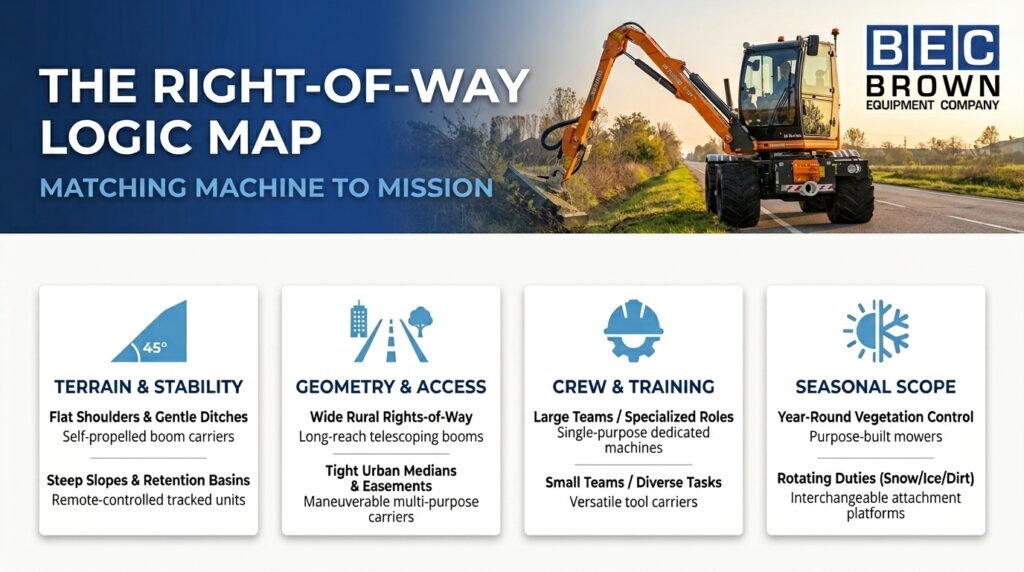
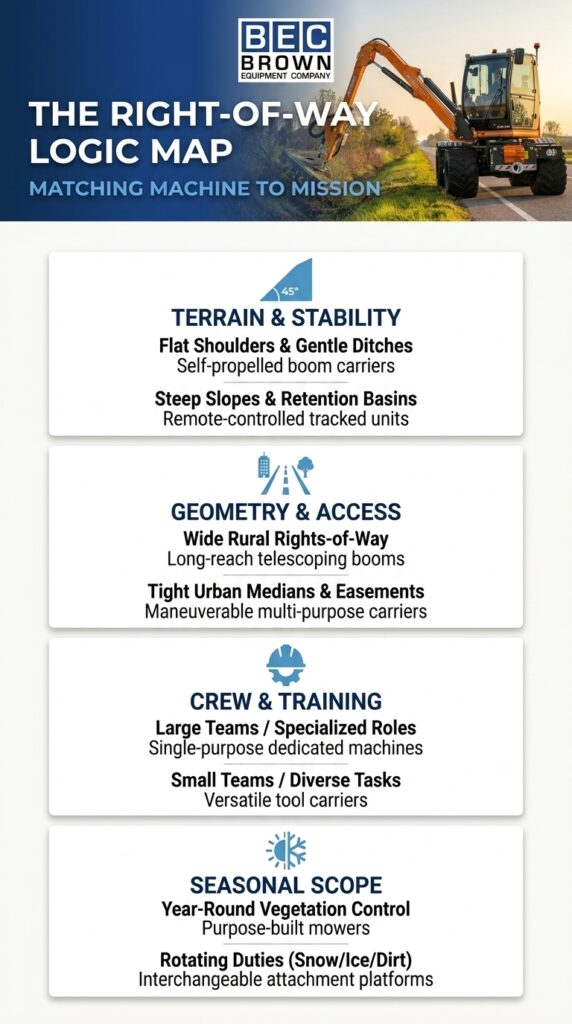
Equipment selection should map to four operational variables: terrain, right-of-way geometry, crew size and skill, and seasonal demand. Walk through them in this order before deciding what to own outright versus rent on demand.
1. Terrain
Flat shoulders and gently sloped ditches are well-served by self-propelled boom carriers. The operator stays in the cab and works long stretches with high throughput. Steep slopes (anything that would put a riding operator at rollover risk), retention basins, and unstable embankments call for remote-controlled tracked carriers. If your service area mixes both, the fleet needs both.
2. Right-of-Way Geometry
Rural roads with wide, regular rights-of-way reward boom carriers with long telescoping reach. Tight urban routes, narrow easements, sidewalk-adjacent verges, and median work reward smaller, more maneuverable carriers, including multi-purpose tool carriers that can move on public roads at low speed without trailers. If most of your work is in narrow corridors, a single large boom carrier may sit underutilized while smaller machines do the day-to-day work.
3. Crew Size and Skill
A small crew gets more out of fewer, more versatile carriers. A larger crew with dedicated specialists can run multiple single-purpose machines efficiently. Operator training is a real factor: boom carriers and remote-controlled units both have learning curves, and the cost of an undertrained operator on a complex machine shows up in damage, downtime, and quality. Factor in how much training the existing crew can absorb and whether the dealer offers structured operator training as part of the sale.
4. Seasonal Demand
If your vegetation crew also handles snow, ice, sweeping, or other seasonal duties, a multi-purpose tool carrier may earn its keep where a single-season boom mower wouldn’t. If vegetation is a year-round responsibility, purpose-built vegetation carriers (boom or remote-controlled) typically deliver better throughput than swapping attachments on a generalist platform.
Operator Safety as a Fleet Design Factor
Operator safety is a fleet decision, not just a training one. Grounds maintenance work is among the more dangerous occupations in the U.S. economy: the Bureau of Labor Statistics recorded 226 fatal injuries among grounds maintenance workers (SOC 37-3010) in 2023. That figure spans the full grounds maintenance category, not just roadside-specific work, but the operating risks (slope, traffic, blade exposure, rollovers) are concentrated where vegetation crews actually work.
Fleet composition affects exposure. The proportion of work each category handles is, in effect, a safety control:
- Remote-controlled carriers reduce operator exposure on the highest-risk surfaces by removing them from the slope entirely.
- Self-propelled boom carriers reduce exposure to traffic by letting the operator work from a protected cab away from the lane edge.
- Walk-behind and hand-trimmer work fills gaps powered equipment can’t reach, but it carries the highest direct exposure of any roadside method.
After-Sales Support, Service, and Lifecycle Considerations
Equipment selection isn’t complete at the purchase. Total cost of ownership over a 7-to-15-year service life is driven less by sticker price than by uptime, parts availability, training, and how fast a service team can get a downed machine back in the field. When the fleet runs equipment from a dealer that handles ongoing maintenance, repairs, and reconditioning, crews spend more time mowing and less time waiting on parts.
Two practical questions worth raising with any prospective dealer:
- Do they support multi-state coverage if your operation crosses jurisdictions?
- Do they offer demo programs that put a candidate machine on your terrain, with your operators, before you buy? Specs on a brochure won’t tell you whether a particular boom geometry will work on your specific shoulder profile.
Brown Equipment Company operates across the Midwest from multiple service center locations. Equipment Consultants on the team can help fleets work through the decisions described above and recommend the mix of equipment that fits, not just the equipment we’d most like to sell.
Frequently Asked Questions About Roadside Vegetation Management Equipment
What is the difference between a boom mower and a flail mower?
A boom mower is a carrier: typically a self-propelled or tractor-mounted machine with a hydraulic arm that extends a cutting head out away from the operator. A flail mower is a type of cutting head, made up of small swinging blades on a horizontal drum, that excels at tougher, woodier vegetation. The two terms describe different things, and a boom mower can have a flail head attached to it. Most public works fleets need both reach (boom) and brush capability (flail head).
Is a boom mower necessary for municipal roadside maintenance?
Boom mowers are the most efficient option for long stretches of shoulder and ditch work, particularly on rural roads where the right-of-way is wide and traffic is moving fast. They aren’t strictly necessary. Smaller municipalities with mostly urban routes, narrow easements, and short mowing distances can get by with multi-purpose tool carriers and remote-controlled units. The decision depends on how many lane-miles of rural shoulder your crew is responsible for and how much of that work is currently being done with under-sized equipment or by hand.
How can I improve worker safety on steep roadside slopes?
The most direct fleet-level intervention is to shift slope work onto remote-controlled tracked carriers, which keep the operator off the slope entirely. These machines are designed for terrain that creates rollover risk for riding equipment, and they let crews handle ditch banks, retention basins, and embankments without putting an operator on the unstable surface. Pair the equipment change with operator training, route planning that reduces traffic exposure, and a written safety protocol.
Should we buy or rent roadside vegetation management equipment?
Equipment that runs most weeks of the working year (the workhorse carriers) generally pencils out better as a purchase. Equipment used for specialized or seasonal needs, like a forestry mulcher used a few weeks per year for brush clearing, often makes more sense as a rental. Many fleets blend both: own the carriers they run constantly, rent specialized machines on demand, and rely on the dealer’s service team to keep the owned equipment running.
What is integrated roadside vegetation management?
Integrated roadside vegetation management (IRVM) is a strategic approach that combines mechanical mowing, targeted herbicide use, biological controls, and habitat management into a single program, instead of relying on schedule-based mowing alone. The goal is to manage roadside vegetation for safety, drainage, and ecological outcomes at the lowest sustainable cost. Equipment selection plays a defined role in IRVM: the right carriers and attachments make targeted, less-frequent intervention practical.
Find the Right Equipment Mix for Your Public Works Department
Building a roadside vegetation management fleet starts with an honest read of your terrain, your right-of-way mix, your crew, and your seasonal pattern. From there, the decision is which equipment categories deserve a seat in the fleet, and at what depth. Contact the Brown Equipment Company team to talk through your operation with an Equipment Consultant, see candidate carriers and attachments demonstrated on your own terrain, and build a fleet plan that matches the work.