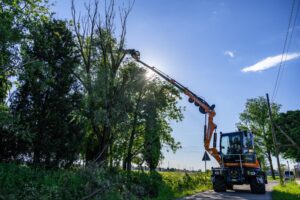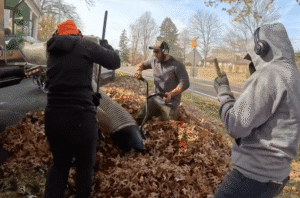
Steep slopes, embankments, and uneven terrain rank among the most hazardous and least efficient areas to mow with conventional equipment. Whether you manage roadside right-of-way, retention ponds, levees, or municipal parks, the challenge is the same: traditional mowing methods put operators in harm’s way on unstable ground where rollovers, slips, and loss of control are constant threats. A remote-controlled slope mower changes that equation by removing the operator from the danger zone entirely, allowing one person to handle terrain that would otherwise require a full crew or go unmaintained.
But does a remote-controlled mower make sense for every steep-terrain application? The answer depends on your terrain, crew size, maintenance frequency, and budget. This guide breaks down the key differences between remote-controlled slope mowers and traditional mowing methods across safety, productivity, cost, and common use cases so you can make a confident equipment decision.
Key Takeaways
Here are the most important points covered in this comparison:
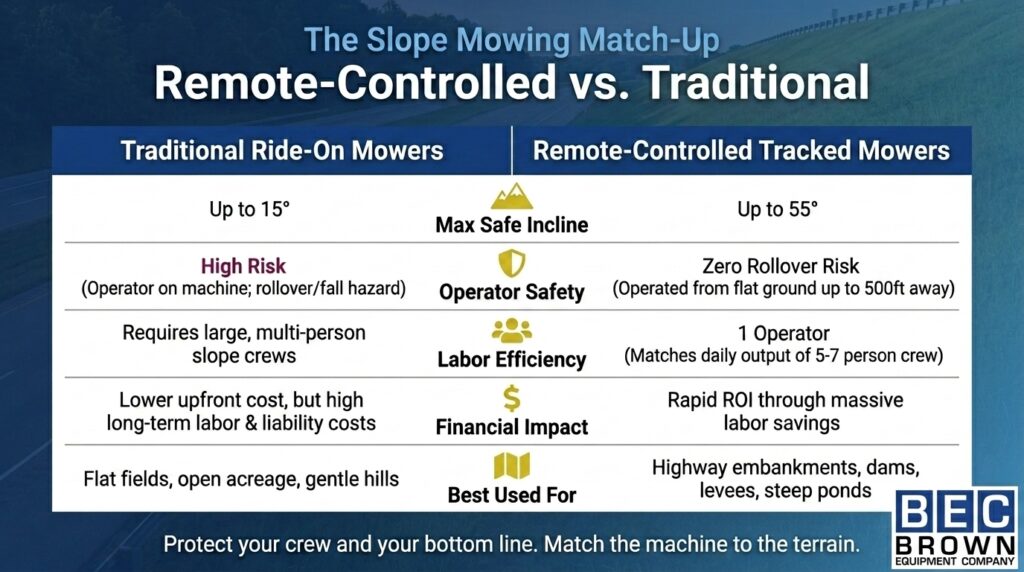
- Safety gap is significant: OSHA recommends against operating riding mowers on slopes exceeding 15 degrees without manufacturer guidance. Remote-controlled slope mowers can handle grades of 50–55 degrees while the operator stays on flat ground.
- Labor efficiency improves dramatically: One operator with a remote-controlled mower can often replace a multi-person string-trimming crew, completing the same work in a fraction of the time.
- Rollover risk drops to near zero for operators: Since fall 2019, OSHA has documented 35 worker fatalities from riding mower rollovers. Remote operation eliminates direct operator exposure to tip-over incidents.
- Traditional mowing still has a role: For flat or gently sloped terrain under about 15 degrees, conventional ride-on mowers remain cost-effective and practical for routine maintenance.
- Total cost of ownership matters more than sticker price: Remote-controlled mowers carry higher upfront costs but can reduce labor, insurance, and liability expenses over time, especially for operations that regularly maintain steep or hazardous terrain.
- Versatility adds value: Many remote-controlled carriers accept multiple attachments beyond mowing decks, consolidating equipment needs across vegetation management tasks.
Why Steep Terrain Demands a Different Mowing Approach
Slopes change everything about a mowing operation. On flat ground, a standard ride-on mower is efficient, predictable, and relatively safe. Introduce a grade steeper than 15–20 degrees, and the risks escalate quickly. OSHA’s guidance on riding mower rollovers warns operators to avoid slopes exceeding manufacturer-specified limits and recommends a 15-degree maximum when no manufacturer guidance is available.
The consequences of getting this wrong are severe. According to the U.S. Department of Labor, 35 workers died in lawn mower rollover incidents between fall 2019 and September 2022. Commercial riding mowers can weigh upward of 1,500 pounds, and when they overturn on a slope, the results are often fatal. Meanwhile, walk-behind and string-trimming crews working steep grades face their own hazards: slips, falls, repetitive strain, heat exposure, and contact with flying debris.
Beyond safety, steep terrain reduces productivity. Traditional mowers lose traction, require slower speeds, and often can’t reach every area, leaving sections unmaintained. Crews may need multiple passes or manual follow-up work, increasing labor hours and overall costs per acre.
What Is a Remote-Controlled Slope Mower?
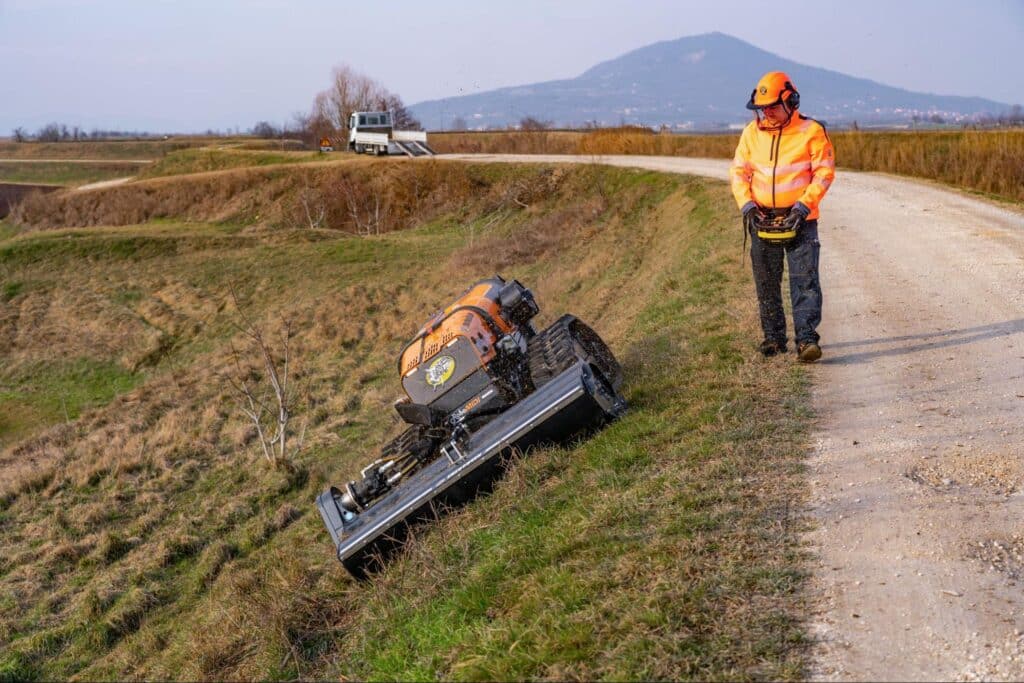
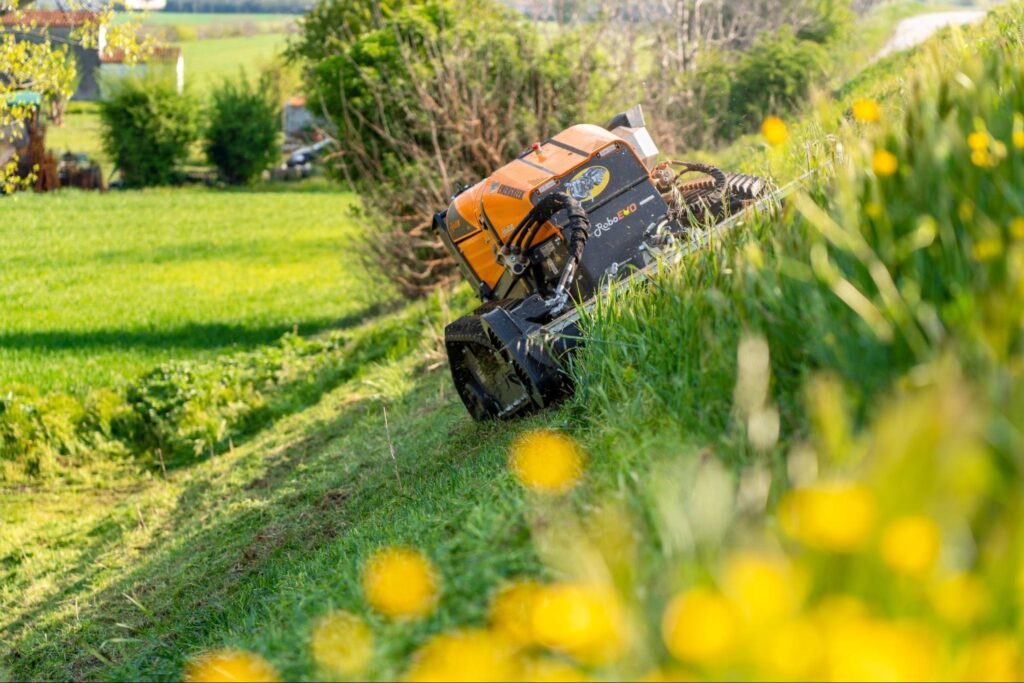
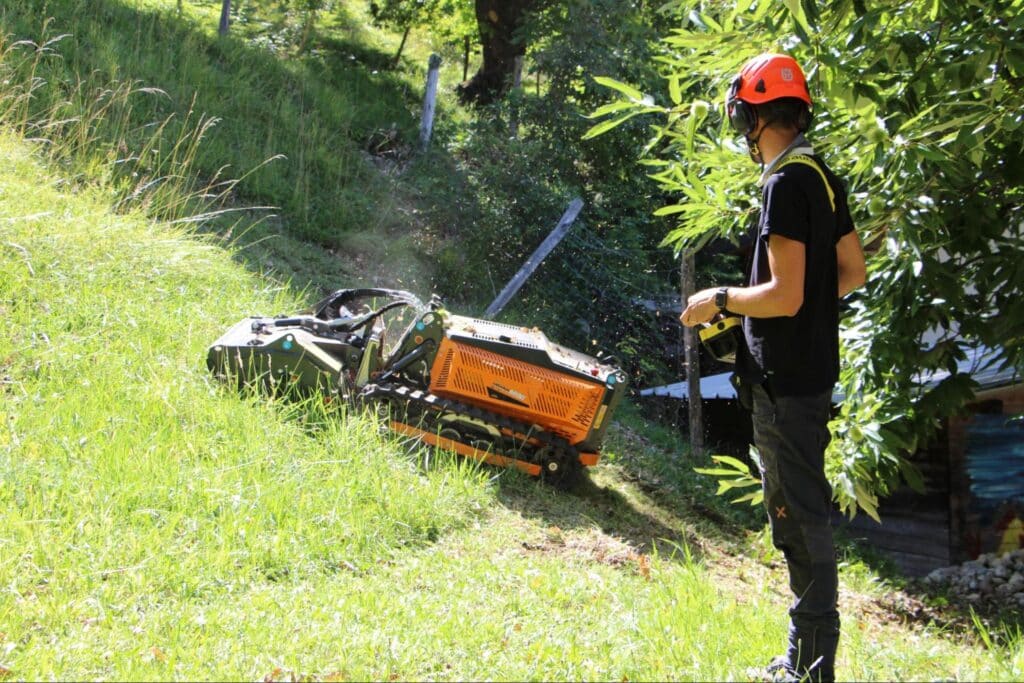
A remote-controlled slope mower is a tracked or wheeled machine designed specifically for steep and uneven terrain, operated by a single person using a handheld radio controller from a safe distance. Unlike autonomous robotic mowers that follow pre-programmed paths, these machines give the operator full real-time control over speed, direction, and cutting functions through direct line-of-sight operation.
Most commercial-grade remote-controlled slope mowers share several key design features:
- Low center of gravity and wide track footprint for stability on grades of 50 degrees or more
- Tracked drive systems that maintain grip on wet grass, mud, and loose soil without the ground-pressure problems of heavy rider equipment
- Radio control range that keeps operators hundreds of feet from the cutting zone, eliminating exposure to noise, vibration, exhaust, and debris
- Quick-change attachment systems that allow the same carrier to run mowing decks, flail heads, forestry mulchers, and other vegetation management tools
Energreen’s Robo series, for example, features machines designed to work on slopes of 50–55 degrees (with some configurations reaching approximately 60 degrees), powered by professional-grade diesel or gasoline engines and supported by hydraulic systems engineered for high-angle operation. You can explore Energreen’s full product lineup to see how these machines are configured for different terrain and application requirements.
Safety Comparison: Remote-Controlled vs. Traditional Slope Mowing
Safety is the most compelling reason organizations switch to remote-controlled mowing on steep terrain. The differences are not marginal; they represent a fundamentally different risk profile.
Operator Exposure
With traditional ride-on mowers, the operator sits directly on the machine as it traverses the slope. If the mower tips, slides, or loses traction, the operator goes with it. Walk-behind crews fare better in terms of rollover risk but face prolonged physical strain, uneven footing, and exposure to thrown objects at close range.
Remote-controlled mowers eliminate this exposure entirely. The operator stands on stable, flat ground while controlling the machine from a distance, typically 150 to 500 feet away depending on the model and terrain. If the machine encounters a problem on the slope, the operator is not at risk.
Rollover and Tip-Over Risk
OSHA’s data makes the rollover risk clear. The agency has identified slopes, wet surfaces, drop-offs, and proximity to water features as primary rollover hazards for riding mowers. Remote-controlled mowers are built with stability features that address these exact conditions: wide track bases, low profiles, and enclosed fail-safe braking systems that engage automatically if the engine stops or signal is lost.
Ergonomic and Environmental Hazards
Operating any mower on a slope exposes the person on the machine to whole-body vibration, engine noise, exhaust fumes, and thrown debris. Over a full workday, these exposures contribute to hearing damage, musculoskeletal injuries, and respiratory issues. Remote operation removes the operator from all of these hazards simultaneously, which can also help reduce workers’ compensation claims and long-term health-related costs.
Productivity and Efficiency: How the Two Approaches Compare
On flat terrain, conventional mowers are fast and efficient. On steep slopes, the equation shifts significantly in favor of remote-controlled equipment.
Coverage Rate and Crew Size
A single operator running a remote-controlled slope mower can often match or exceed the output of a five-to-seven-person string-trimming crew on the same slope. The machine doesn’t slow down from fatigue, doesn’t require rest breaks mandated by heat stress protocols, and maintains a consistent cutting speed across the full grade. Some models cover more than two acres per hour on slopes that would take a conventional crew an entire day to finish manually.
This labor efficiency is particularly relevant given ongoing workforce challenges in vegetation management. Replacing a multi-person slope crew with a single operator frees workers for other tasks or helps operations that struggle to fill seasonal positions.
Access to Difficult Areas
Remote-controlled mowers reach areas that traditional equipment simply cannot maintain safely: dam faces, levee embankments, retention pond slopes, roadside ditches, bridge abutments, and terrain around water features. When conventional mowers can’t access these areas, they either go unmaintained (creating compliance and safety issues) or require expensive hand labor.
Consistent Cut Quality
Tracked remote-controlled mowers follow the contour of the ground more closely than wheeled ride-on equipment, reducing scalping on high spots and missed patches in low areas. The operator’s ability to control the machine precisely from a vantage point above the slope often produces a more uniform result than a rider fighting to maintain control while seated on the same incline.
Cost Considerations: Upfront Investment vs. Long-Term Value
Remote-controlled slope mowers represent a larger upfront investment than most conventional mowing equipment. Commercial-grade units typically range from the mid-five figures into six figures depending on the model, engine, and attachment configuration. By comparison, a commercial zero-turn mower or tractor-mounted deck costs significantly less at the point of purchase.
However, total cost of ownership on steep-terrain jobs often favors the remote-controlled option when you account for the full picture:
- Labor reduction: Replacing a multi-person slope crew with one operator delivers the most significant ongoing savings. Fewer worker-hours per job means lower payroll, benefits, and seasonal staffing costs.
- Insurance and liability: Removing operators from rollovers, slope falls, and vibration exposure can help reduce workers’ compensation premiums and incident-related costs over time.
- Equipment consolidation: Machines that accept multiple attachments can replace several single-purpose tools, reducing your fleet count and associated maintenance expenses.
- Reduced downtime: Professional-grade remote-controlled mowers are built for daily commercial use on demanding terrain. Purpose-built components last longer under slope stress than general-purpose mowers pushed beyond their design limits.
For operations that mow steep terrain frequently, such as municipal departments maintaining highway embankments or contractors with recurring slope contracts, the payback period can be relatively short. For crews that encounter steep slopes only occasionally, a rental arrangement may offer a practical way to access the capability without the full capital commitment.
Common Use Cases for Remote-Controlled Slope Mowers
Remote-controlled mowers are designed for specific high-value applications where traditional equipment creates unacceptable risk or simply can’t perform. Here are some of the most common scenarios where remote-controlled equipment delivers the strongest return:
- Highway and roadside right-of-way: DOT and municipal crews maintain miles of embankments, median slopes, and interchange landscapes that exceed safe angles for conventional mowers.
- Dam and levee maintenance: Federal and state regulations require regular vegetation management on dam embankments. These grades are often 2:1 or steeper, well beyond the limits of ride-on equipment.
- Retention and detention ponds: Stormwater management sites frequently have steep, wet slopes where rollover risk and turf damage from heavy equipment are primary concerns.
- Utility right-of-way and solar farms: Maintaining vegetation under and around infrastructure installations on sloped terrain requires precision and low ground pressure.
- Parks, campuses, and public spaces: Agencies responsible for public areas with steep landscaping features benefit from the safety and appearance improvements that come with consistent mechanical mowing over hand trimming.
When Traditional Mowing Still Makes Sense
Remote-controlled slope mowers are not the right tool for every mowing job. Traditional equipment remains the practical choice in several scenarios:
- Flat and gently sloped terrain: For grades under about 15 degrees, ride-on mowers deliver fast, efficient coverage at a lower equipment cost.
- Large open acreage: Wide-deck zero-turn mowers and tractor-mounted rotary cutters cover flat ground faster and more economically than tracked slope mowers.
- Budget-constrained operations with minimal slope work: If steep-terrain mowing represents only a small fraction of your workload, the investment in dedicated slope equipment may not be justified. Spot rentals or subcontracting may be more cost-effective.
The most effective approach for many operations is a combination: conventional equipment for flat and moderate terrain, and remote-controlled mowers for the steep, hazardous zones that demand them. Understanding your terrain profile is the first step in making that determination.
What to Look for When Evaluating Remote-Controlled Slope Mowers
If your operation is considering a remote-controlled mower, here are the factors that matter most when comparing options:
- Maximum slope rating: Verify the manufacturer’s rated slope capacity under working conditions, not just static stability. Wet grass and loose soil reduce effective climbing ability.
- Attachment versatility: A machine that runs mowing decks, flail heads, forestry mulchers, and other tools offers more value than a dedicated mower. Review the attachment catalog and quick-change system.
- Dealer support and service: Parts availability, field support, and trained service technicians matter more with specialized equipment than with commodity mowers. Ask about warranty terms, service response times, and parts lead times.
- Operator training: Remote-controlled mowers have a learning curve. Evaluate what training the dealer or manufacturer provides and whether on-site demonstrations are available.
- Transport and logistics: Check the machine’s weight, dimensions, and trailer compatibility. Some models fit on standard landscape trailers; others require dedicated transport.
Seeing the machine in action on your actual terrain is one of the most valuable steps you can take. A free on-site demonstration allows your team to evaluate performance, ease of operation, and suitability before committing to a purchase.
Choosing the right equipment is only part of the equation. See how Brown Equipment Company’s service-first approach supports customers from initial consultation through ongoing maintenance and field support.
Frequently Asked Questions About Remote-Controlled Slope Mowers
How steep of a slope can a remote-controlled mower handle?
Most commercial-grade remote-controlled slope mowers are rated for slopes between 40 and 55 degrees, with some models and configurations reaching approximately 60 degrees. By comparison, OSHA recommends a maximum of 15 degrees for riding mowers when manufacturer specifications are unavailable. Actual performance depends on ground conditions, turf quality, and moisture levels, so it’s important to evaluate equipment on your specific terrain.
Are remote-controlled slope mowers difficult to operate?
Most operators become comfortable with the controls within a few hours of practice. Handheld radio controllers use intuitive joystick inputs for speed and direction. The learning curve is less about the controls themselves and more about developing good sightlines and mowing patterns on slopes. Reputable dealers offer operator training as part of the purchase or rental process.
Can one remote-controlled mower really replace a full slope crew?
In many applications, yes. A single operator with a remote-controlled mower can match the output of a five-to-seven-person string-trimming crew on steep terrain, often completing the work in significantly less time. The machine doesn’t need breaks, doesn’t fatigue, and maintains consistent cutting speed. However, some sites with tight access, obstacles, or mixed terrain may still benefit from supplemental hand work in specific areas.
Do remote-controlled mowers require special maintenance?
Routine maintenance is similar to other commercial mowing equipment: engine service, blade or flail replacement, track inspection, and hydraulic system checks. The key difference is that tracked drive systems and hydraulic components may require attention from technicians experienced with this equipment class. Working with a dealer that provides ongoing maintenance and parts support helps ensure consistent uptime.
Is renting a remote-controlled slope mower an option?
Yes. Renting is a practical way to evaluate whether a remote-controlled mower fits your operation before making a full purchase. It’s also a cost-effective option for seasonal projects or occasional steep-terrain jobs. Ask your equipment dealer about short-term and long-term rental availability.
Find the Right Slope Mowing Solution for Your Operation
Choosing between remote-controlled and traditional mowing comes down to terrain, safety requirements, crew availability, and how often your operation faces steep or hazardous conditions. For many municipalities, contractors, and utility operators across the Midwest, remote-controlled slope mowers have become an essential part of a well-rounded vegetation management program.
Brown Equipment Company provides Energreen remote-controlled mowers and tool carriers backed by sales, service, rentals, and hands-on support from seven service centers across the Midwest. Whether you’re ready to purchase, interested in renting, or want to see a machine perform on your terrain, the BEC team can help you find the right fit.
Ready to evaluate your options? Contact Brown Equipment Company to discuss your slope mowing needs or schedule a free on-site demonstration.