When a utility strike or pipeline exposure job comes up, the equipment on-site determines how much time, money, and regulatory risk your crew takes on. The Hydro-Spade is a dedicated hydro excavation unit designed for municipalities, contractors, and utility operators who need precision digging without the risks and restrictions of traditional mechanical excavation. This post covers how it works, what sets it apart, and how to choose the right configuration for your operation.
Key Takeaways
- The Hydro-Spade is a hydro excavation unit that combines high-pressure water and vacuum extraction in a single machine, available in truck and trailer configurations.
- No CDL is required to operate the Hydro-Spade, giving municipalities and contractors more flexibility in operator assignments without adding a CDL-certified driver requirement.
- Truck models carry a 600 or 800-gallon debris tank, a 1,000-gallon water tank, and 12 cubic yards of debris capacity, plus a hydraulic boom for extended reach on difficult sites.
- Trailer models offer debris tank options from 400 to 800 gallons, an 8-cubic-yard debris capacity, and a lower entry point for fleets without a dedicated hydro truck.
- Heated water tanks and freeze protection make both configurations suitable for year-round operation, including cold-weather projects.
- Brown Equipment Company provides Hydro-Spade units, on-site demonstrations, and service support across a six-state Midwest territory.
How Hydro Excavation Works
Hydro excavation breaks up soil with pressurized water, then removes the loosened material through a vacuum system into an onboard debris tank. The process is precise and controlled, which makes it practical for any situation where a backhoe or trencher would risk damaging buried utilities, conduit, or pipelines.
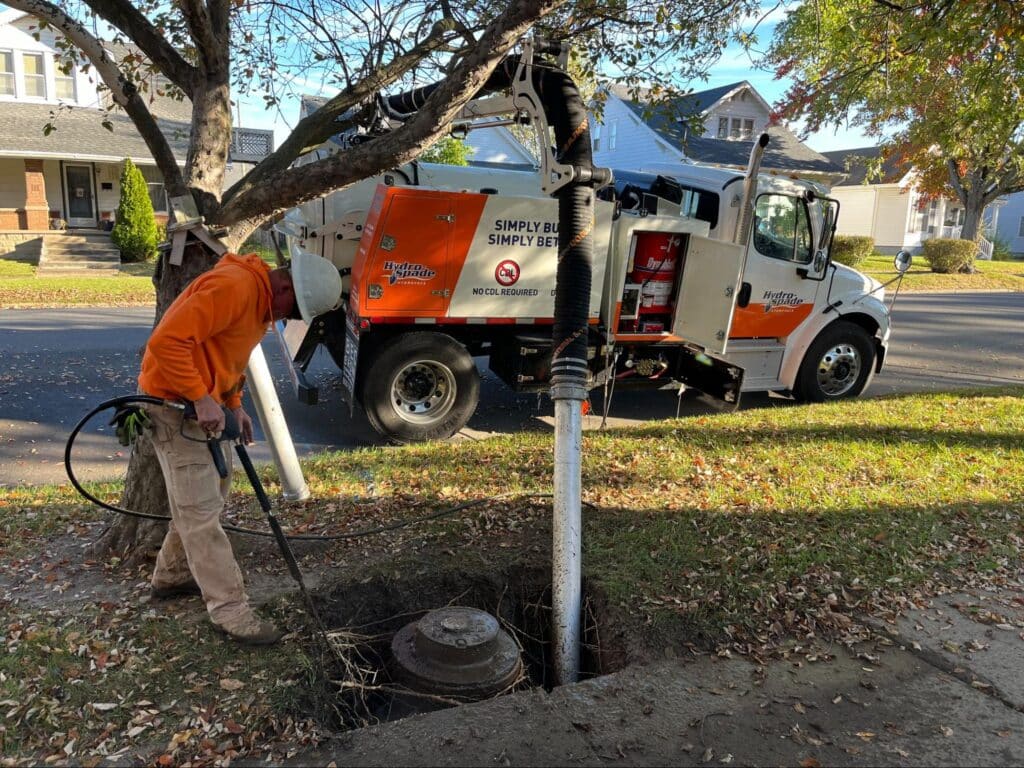
In practice, a crew positions the unit near the dig zone. A pump drives pressurized water through a flexible wand to break up soil at the target location, while a vacuum simultaneously draws the loosened slurry into the onboard debris tank. Collected material is transported for off-site disposal or returned to the excavation for backfill when the job is complete.
How Is a Hydrovac Truck Different from a Standard Vacuum Truck?
A standard vacuum truck removes liquid and loose material through suction only. A hydrovac truck combines pressurized water to break up compacted soil with vacuum extraction to remove the resulting slurry. That combination is what allows controlled, non-destructive excavation. Standard vacuum trucks cannot break up undisturbed soil and are not hydro excavation equipment.
Common Applications
Hydro excavation is used most frequently for:
- Daylighting: safely exposing the top of a buried utility before mechanical digging begins
- Utility repair and exposure: uncovering pipelines, conduit, and underground infrastructure for inspection or repair
- Slot trenching: cutting precise, narrow trenches for utility installations in areas where wide disturbance is not acceptable
- Debris removal: clearing material from confined or restricted-access areas where mechanical equipment cannot reach
Daylighting is the primary use case driving adoption among municipalities and contractors. Utility strikes from traditional digging rank among the most common causes of project delays, budget overruns, and regulatory liability for public works departments. Daylighting with a hydro unit can help reduce that risk before it starts.
Hydro-vacuum excavation equipment is recognized as an acceptable method for utility locating when adjusted to prevent underground utility damage, per a standard interpretation from the Occupational Safety and Health Administration. That regulatory standing matters for public works departments and contractors managing compliance requirements on utility excavation work.
The scale of the problem is significant. The Common Ground Alliance 2024 DIRT Report documented nearly 197,000 utility damage incidents across the U.S. and Canada in 2024, and the overall trend is moving in the wrong direction. For public works departments managing aging infrastructure and tight budgets, each of those incidents represents an unplanned project shutdown, emergency repair cost, and regulatory exposure that non-destructive excavation is specifically designed to prevent.
What Sets the Hydro-Spade Apart
The Hydro-Spade is built for municipal and contractor operations that need hydro excavation capability without the workforce and operational constraints that come with most full-size units. Four features distinguish it from standard hydrovac trucks:
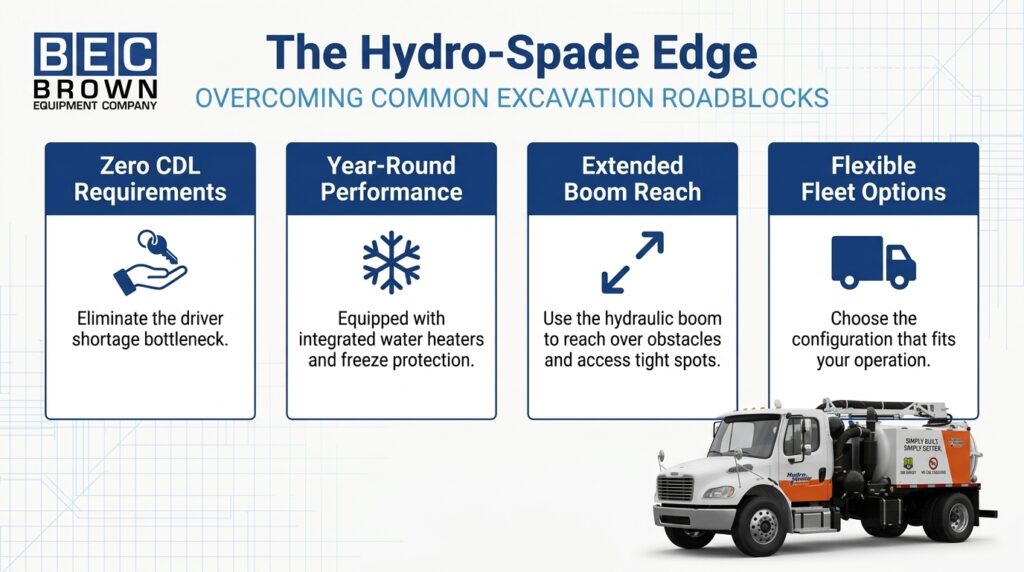
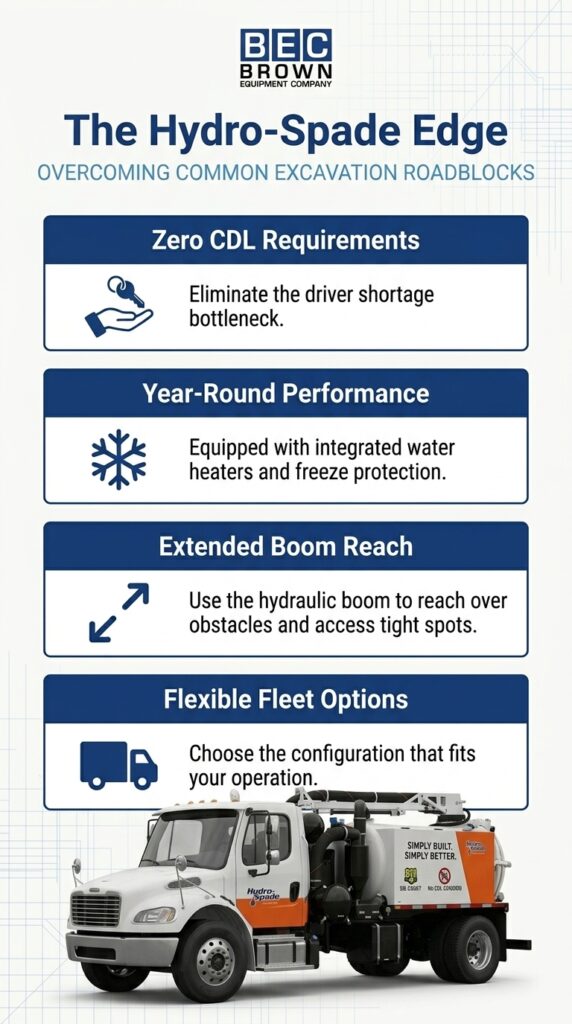
- No CDL required: The Hydro-Spade is engineered for operation without a commercial driver’s license. For fleet managers responsible for scheduling crews, this removes a persistent bottleneck when CDL-certified operators are limited or unavailable.
- Year-round capability: Heated water tanks and freeze protection allow cold-weather operation without seasonal downtime. BEC’s guide to cold-weather hydro excavation practices covers operating specifics for winter conditions in more detail.
- Hydraulic boom (truck model): When the vehicle cannot be positioned directly over the excavation site, the hydraulic boom extends reach without requiring the crew to reposition the truck. This is a meaningful advantage on sites with limited access or overhead obstacles.
- Two configurations: The truck and trailer options address different job scales and fleet situations, giving operations a practical choice rather than a single fixed setup.
The Hydro-Spade is sold and serviced through Brown Equipment Company, a dealership and service provider for municipalities and contractors across the Midwest. Brown Equipment Company is not the manufacturer.
Hydro-Spade Configurations: Truck vs. Trailer
Choosing between the truck and trailer comes down to debris capacity requirements, job frequency, and how the unit will be deployed. The table below compares the key specs, drawn from the Hydro-Spade product page.
| Truck | Trailer | |
| Debris tank | 600 or 800 gal. | 400, 600, or 800 gal. |
| Water tank | 1,000 gal. | 500 gal. |
| Debris capacity | 12 cu. yd. | 8 cu. yd. |
| Hydraulic boom | Yes | No |
| CDL required | No | No |
The truck model carries significantly more water per fill, which reduces repositioning time on high-volume utility exposure work. For jobs requiring extended footage of utility exposure in a single shift, the 1,000-gallon water tank and 12-cubic-yard debris capacity mean fewer trips to empty or refill. The hydraulic boom adds reach on sites where the truck cannot be positioned directly over the dig.
See the Hydro-Spade truck up close. This walkaround covers the key features, tank configurations, and hydraulic boom system that make it a fit for high-volume utility excavation work.
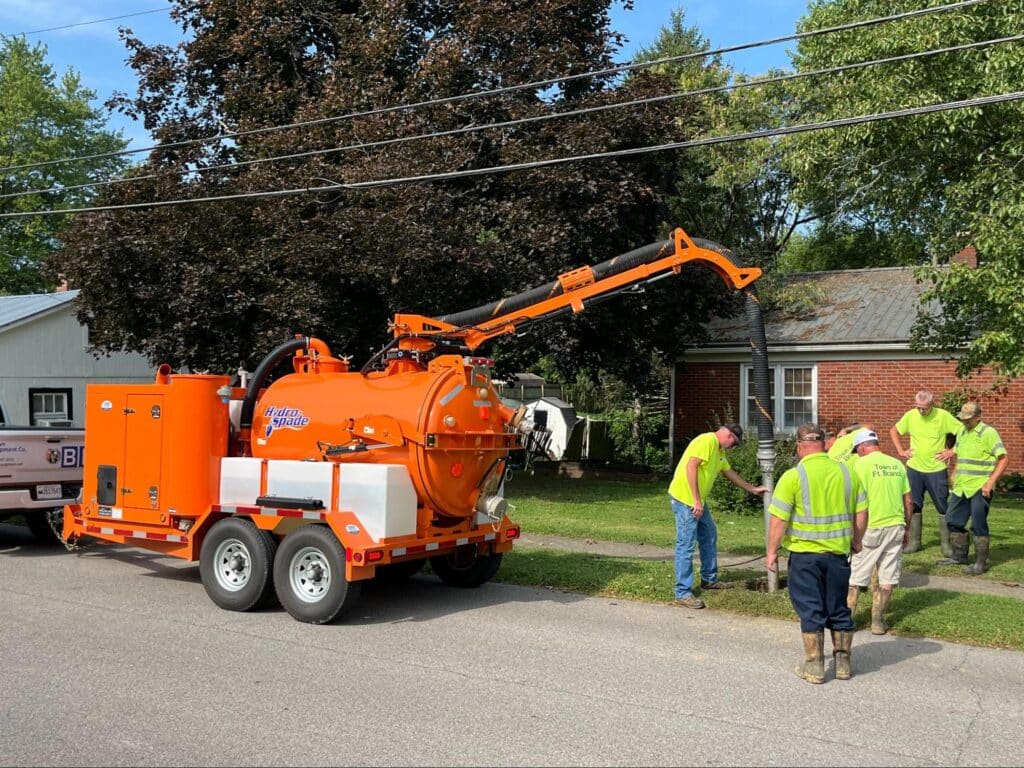
The trailer configuration offers a more flexible entry point for fleets that already have appropriate tow vehicles. For utility corridor work or confined-access situations where a full-size truck is difficult to maneuver, the trailer’s compact footprint is a practical advantage. BEC’s post on effective narrow trench excavation covers job conditions where smaller configurations consistently outperform full-size trucks.
Considering the trailer configuration? This walkaround shows the Hydro-Spade trailer and its features for fleets that need flexible, compact hydro excavation capability.
Why Municipalities Are Choosing Hydro Excavation Over Traditional Methods
The operational case for hydro excavation over traditional mechanical digging comes down to three factors: safety, cost, and speed. Here is how each one plays out in the field:
- Safety: Traditional excavation with backhoes and trenchers operates with limited precision near buried infrastructure. A single utility strike can shut down a project, trigger emergency repair costs, and create regulatory notifications and liability that outlast the job itself. Hydro excavation can help reduce that risk by giving crews a non-destructive digging method that exposes utilities without mechanical contact.
- Cost: The direct repair cost of a utility strike is only part of the financial exposure. Work stoppages, crew downtime, surface restoration, service interruptions, and regulatory consequences compound quickly. Peer-reviewed research published in Infrastructure Asset Management found that for every dollar of direct utility strike repair costs, the indirect and social costs alone — service disruptions, traffic delays, lost productivity, and regulatory consequences — average 29 times more. For public works departments, that math makes avoiding a single strike worth a significant investment in prevention.
- Speed: On utility exposure and daylighting tasks, hydro excavation consistently outpaces cautious mechanical work near buried infrastructure. Operators can target and expose utilities with precision rather than stopping repeatedly to hand-dig and reassess, keeping crew hours and project timelines from compounding.
The OSHA recognition of hydro-vacuum excavation for utility locating reinforces its standing as a sound operational practice across the industry. For a deeper look at the performance case, BEC’s post on the key benefits of hydro excavation covers the topic in more depth.
Frequently Asked Questions About the Hydro-Spade
What are hydro excavation trucks used for?
Hydro excavation trucks are used for daylighting underground utilities before mechanical digging begins, exposing pipelines and conduit for inspection or repair, slot trenching for utility installations, and removing debris from confined or restricted-access areas. The Hydro-Spade handles all of these applications in a single unit, in configurations sized for different job scales.
How much does a hydrovac truck cost?
Hydrovac truck pricing varies based on configuration, tank size, and specification. BEC does not publish list pricing because the Hydro-Spade’s cost depends on which configuration fits your operation. Reach out to the Brown Equipment Company team for current pricing and availability on both the truck and trailer models.
Does the Hydro-Spade require a CDL to operate?
No. The Hydro-Spade is designed to operate without a commercial driver’s license. This distinguishes it from many full-size hydrovac trucks that require CDL-certified operators and gives fleet managers more flexibility in crew assignments without reducing excavation capability.
Can the Hydro-Spade operate in winter conditions?
Yes. Both the truck and trailer models include heated water tanks and freeze protection designed for cold-weather use. This allows year-round deployment on utility and infrastructure projects without seasonal shutdowns. For detailed guidance on cold-weather operating practices, BEC’s resource on cold-weather hydro excavation covers the key field considerations.
Talk to the BEC Team About the Hydro-Spade
The Hydro-Spade is available through Brown Equipment Company, with sales, service, and support across Indiana, Kentucky, Ohio, Michigan, Wisconsin, and Illinois. Whether the truck or trailer configuration fits your operation better, the BEC team can walk you through the options, show you the full Hydro-Spade specifications, and schedule a free on-site demonstration.
Contact Brown Equipment Company to ask about availability, request a demo, or get answers on the Hydro-Spade for your specific application.