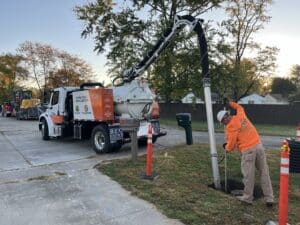
Choosing the correct sewer cleaning method is essential for municipalities, utility contractors, and facility managers responsible for maintaining underground infrastructure. While equipment specifications can be important, the most critical factor is selecting the approach that matches the conditions in the line—hydro-jetting vs traditional mechanical cleaning, or a combination of both.
Sewer systems vary widely by pipe material, age, and the type of blockage present. When the method doesn’t match the job, teams often see recurring clogs, unnecessary downtime, and avoidable wear on already-stressed infrastructure. When the method does match the job, crews can restore flow more efficiently, reduce repeat callouts, and support long-term system performance.
This guide breaks down how hydro-jetting compares to traditional mechanical cleaning, where each method performs best, and how to choose the right workflow based on project goals, pipe condition, and site constraints.
What Counts as “Traditional Sewer Cleaning” (and What It’s Good At)
Traditional sewer cleaning typically includes mechanical cabling, rodding, and cutting. These methods have been widely used for decades to clear specific obstructions. While they may not scour debris from the entire pipe interior, they excel in precision blockage removal and pose minimal risk to older, more delicate pipes.
Mechanical Cabling: Retrieving and Dislodging
Mechanical cabling (snaking) relies on rotating cables to break through blockages. It is especially useful for small to medium-sized clogs and can retrieve foreign objects rather than pushing them down the line.
Rodding and Cutting: Targeting Roots and Hardened Deposits
Specialized rodding and cutting tools slice through tree roots and remove mineral or grease buildup. They often prove essential for older or brittle pipes where high-pressure solutions could potentially weaken the infrastructure. In particular, tree root intrusions can benefit from mechanical cutting, followed by an additional cleaning pass to flush remaining debris.
What Hydro-Jetting Does Differently
Hydro-jetting uses powerful streams of water to clear clogs and remove accumulated material along the pipe walls. This technique is highly effective for eliminating grease, fats, oils, and sediment, thereby improving long-term flow.
Thorough Cleaning and Flushing Action
High-pressure water streams, aided by specialized nozzles, scour the interior surfaces of the pipe. As a result, they dislodge both the immediate blockage and more stubborn buildup that would otherwise accumulate over time.
Considerations and Limitations
Despite its advantages, hydro-jetting requires steady water access and reliable waste management protocols. Very high pressures may not be suitable for older or fragile pipes at risk of cracking. In such cases, operators typically evaluate pipe integrity through inspections first, combining methods if necessary to protect structural stability.
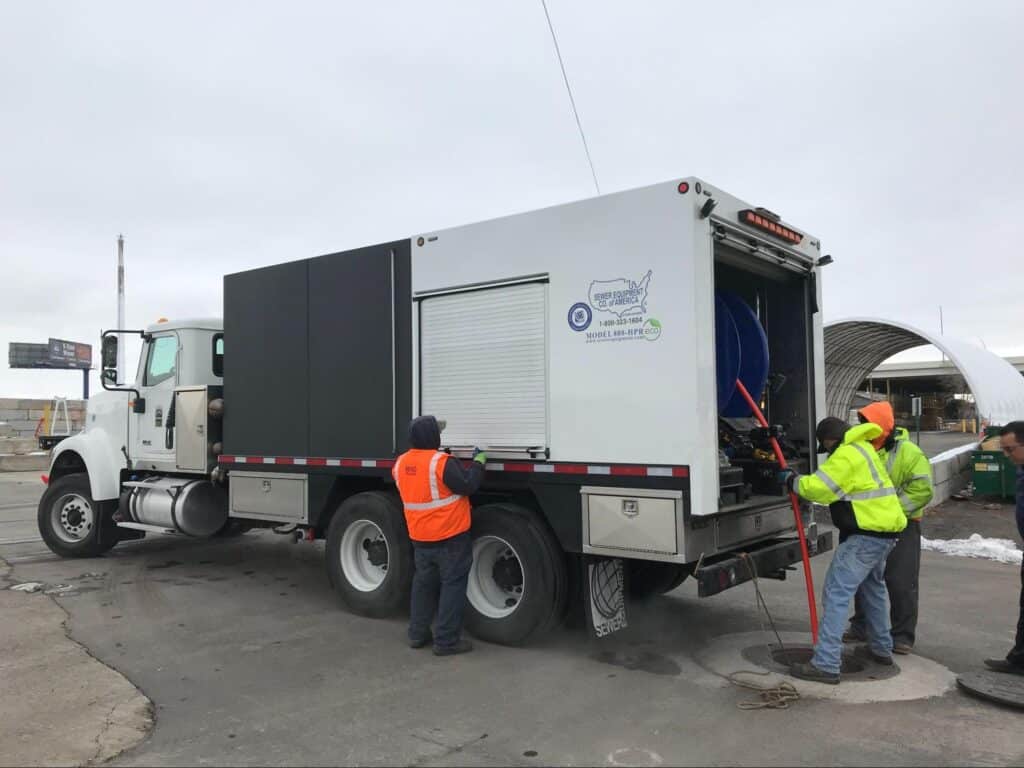
A Practical Decision Framework: Choosing Hydro-Jetting vs. Traditional Cleaning
Use the framework below to make one clear, repeatable decision. The goal is to match the method to the pipe condition, blockage type, and site realities—so you resolve the issue now and reduce the likelihood of repeat callouts.
Step 1: Clarify the Goal—Spot-Clearing or Full Restoration?
Start by defining what success looks like for this job.
- Spot-clearing focuses on restoring flow quickly by addressing a localized blockage. It’s often the right approach for urgent, isolated clogs where the priority is speed and minimal disruption.
- Full restoration aims to remove buildup along the pipe walls—grease, sludge, sediment, and residue—so the line returns closer to full capacity and stays cleaner longer. This is typically the better fit for recurring issues, preventive maintenance programs, and high-volume systems.
As a general rule, mechanical tools are often sufficient for localized obstructions, while hydro-jetting is more effective when the objective is full-diameter cleaning.
Step 2: Match the Method to the Blockage Type
Once the goal is clear, the blockage type usually points to the best method (or the best sequence).
- Grease, fats, oils, and sludge (FOG): Hydro-jetting typically performs best because it scours the pipe interior and flushes material out, rather than leaving residue that can quickly accumulate again.
- Sediment, grit, and heavy deposits: Hydro-jetting is often the stronger option due to its flushing action—particularly in lines where debris collects over long runs.
- Tree roots: Traditional mechanical cutting is commonly the safest and most direct first step for removing intrusions. Hydro-jetting can then follow to flush residual debris and restore improved flow.
- Solid objects and debris retrieval: Mechanical cabling or rodding often has the advantage when retrieval is required. High-pressure water may move material, but it is not designed to recover objects.
Step 3: Evaluate Pipe Condition Before Choosing Pressure or Cutting Force
Method selection should protect the asset, not just clear the symptom.
- Older, fragile, or deteriorating pipes often favor mechanical cleaning because it avoids introducing high pressure into a compromised line.
- Durable pipe materials in sound condition may be well-suited to hydro-jetting when pressures are appropriately controlled and matched to the pipe.
When pipe integrity is unknown—or when a system has repeat blockages—video inspection is frequently the most cost-effective way to confirm what you’re dealing with and avoid making the problem worse.
Step 4: Factor in Site and Operational Constraints
Even the “best” method on paper may be limited by real-world conditions.
- Water access and disposal planning: Hydro-jetting requires reliable water supply and a plan for managing displaced material and wastewater. In remote locations or constrained sites, mechanical tools may be easier to deploy.
- Access and setup time: Mechanical methods are often faster for immediate spot-clearing. Hydro-jetting may take longer to stage, but it can reduce repeat passes when the goal is full restoration.
- Debris removal requirements: If the job demands that debris be removed—not simply moved—hydro-jetting is often paired with vacuum removal to extract material and reduce downstream issues.
Step 5: Choose the Best Workflow (Hydro, Mechanical, or Hybrid)
In practice, many municipalities and contractors get the best results by selecting a workflow—not a single method.
Use Hydro-Jetting When…
- the goal is full-diameter cleaning and long-term flow improvement
- the blockage is primarily grease, sludge, or sediment buildup
- the line is part of a preventive maintenance plan where consistency matters
- the site supports water supply and debris/waste management
Use Traditional Mechanical Cleaning When…
- you need rapid spot-clearing with minimal staging
- the job involves roots requiring cutting, or solid objects requiring retrieval
- the pipe system is older, fragile, or questionable and pressure is a concern
- the site has limited water access or tight working conditions
Use a Hybrid Workflow When…
- roots or solids require mechanical removal first, followed by hydro-jetting to flush and clean
- CCTV inspection confirms mixed conditions (e.g., roots plus grease buildup)
- the objective is to clear the line and leave it as clean as practical to reduce repeat issues
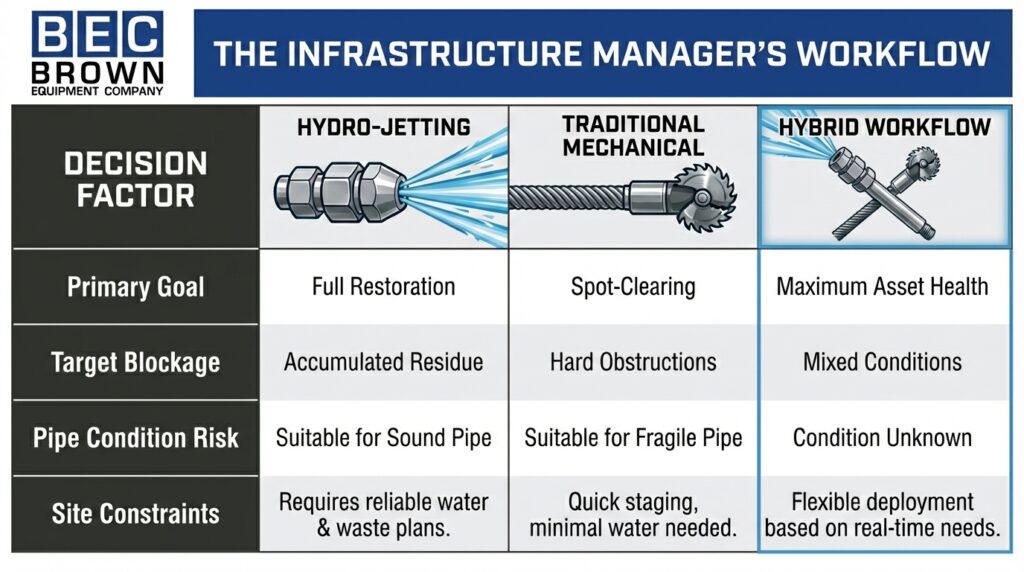
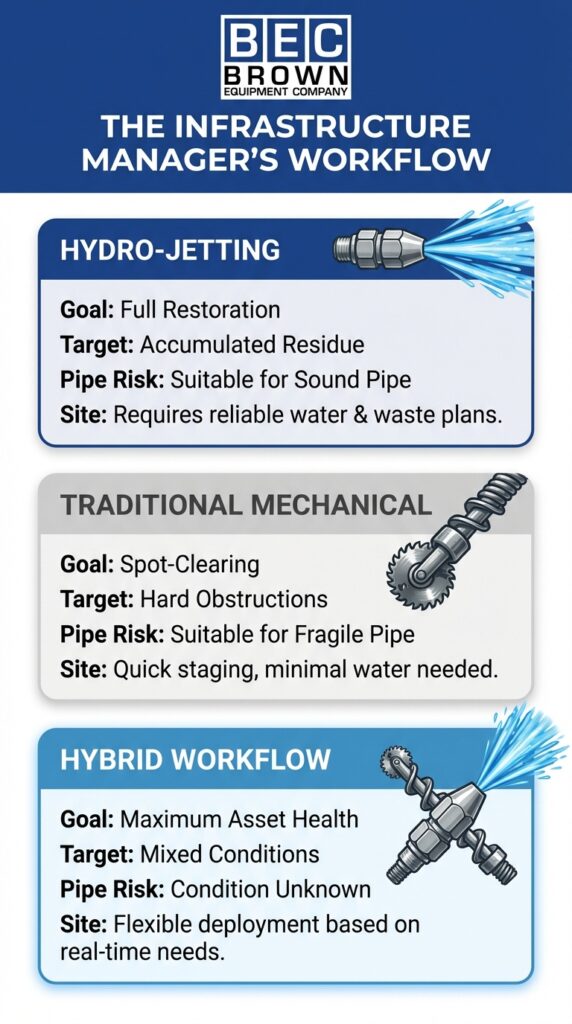
Quick Summary: A Simple “If/Then” Guide
- If the issue is grease/sludge/sediment and you need a more complete clean: Hydro-jetting
- If the issue is roots: Mechanical cutting first, then hydro-jetting to flush
- If the issue is foreign objects or retrieval is required: Mechanical cleaning
- If the pipe is old/fragile/unknown: Inspect first, then choose a conservative approach
- If water access is limited or setup must be minimal: Traditional mechanical cleaning may be the most practical solution
Quick takeaway: Once you’ve evaluated goals, blockage type, pipe condition, and site constraints, use the guidance below as a fast method check.
Use Hydro-Jetting When…
Hydro-jetting is typically the best fit when the objective is to restore full flow capacity by removing buildup along the entire pipe wall—not just opening a path through a clog.
- For Full-Diameter Cleaning: When grease, sludge, sediment, or recurring residue has reduced effective diameter, hydro-jetting provides a more complete clean that helps restore the line closer to full capacity.
- For Preventive Maintenance Programs: For municipalities, facilities, and campuses managing repeat problem areas, scheduled hydro-jetting can reduce emergency callouts by addressing accumulation before it becomes a blockage.
- When Flushing and Debris Transport Matter: Hydro-jetting is well-suited to situations where material needs to be broken up and moved out of the line, especially over longer runs. For large-scale removals, it is often most effective when coordinated with downstream capture or vacuum removal.
Note: As covered in the Decision Framework, hydro-jetting is most effective when pipe condition is confirmed and pressure/nozzle selection are matched to the line.
Use Traditional Mechanical Cleaning When…
Mechanical cleaning remains the most practical solution when the job requires precision removal, retrieval, or conservative force—particularly in sensitive pipe systems or constrained sites.
- For Hard Blockages and Object Retrieval: When solids or foreign objects must be removed (not just displaced), cabling, rodding, or specialty tools can retrieve material and clear localized obstructions with control.
- For Tree Roots and Intrusions That Require Cutting: Mechanical cutting is often the most direct first step for root intrusion. It can be followed by hydro-jetting to flush debris and improve overall cleanliness when conditions allow.
- For Fragile or Older Pipe Systems: When pipe condition is questionable—or the line is known to be brittle—mechanical methods can reduce the risk associated with high-pressure water, especially when paired with CCTV inspection.
- In Areas with Limited Water or Tight Access: Mechanical tools can be faster to deploy for spot-clearing, require less staging, and may be the most feasible option where water supply, access, or disposal planning restrict hydro-jetting.
The “Best Answer” Is Often Both: A Hybrid Workflow
Many municipal and commercial teams use a hybrid approach because real-world lines rarely present just one condition. A hybrid workflow combines the precision of mechanical cleaning with the full-diameter cleaning and flushing of hydro-jetting—often delivering better results with fewer repeat callouts.
Why Hybrid Works
Hybrid cleaning is especially effective when:
- the line has multiple blockage types (roots + grease, solids + sediment)
- the goal is restore flow now while also improving long-term performance
- pipe condition is uncertain and the crew needs a controlled, step-by-step approach
A Common Hybrid Sequence
A typical workflow looks like this:
- CCTV inspection (baseline condition): Operators confirm blockage type, severity, and pipe condition (offset joints, cracks, corrosion, root intrusion, standing water). This step helps avoid applying unnecessary force—either mechanical or high-pressure water—where it could cause damage.
- Mechanical cleaning for removal/cutting: If roots, hardened deposits, or solid objects are present, mechanical tools are often the safest first step. Cutting and retrieval reduce the obstruction without relying on water pressure to “force” material downstream.
- Hydro-jetting for wall-to-wall cleaning: Once the primary obstruction is addressed, hydro-jetting can follow to remove residual grease, sludge, and loosened debris—restoring the pipe closer to full capacity and reducing the chance of immediate re-blockage.
- Debris handling (as required): For heavier cleanouts or larger lines, crews may coordinate jetting with vacuum removal or downstream capture so debris is removed from the system rather than redistributed.
- Final CCTV verification: A post-clean inspection confirms results, documents pipe condition, and supports maintenance planning—especially valuable for municipal reporting and long-term asset management.
This staged approach is also easier to scale across maintenance programs because it standardizes how teams assess, clean, and verify results across different pipe conditions.
Operator Considerations: Safety and Best Practices
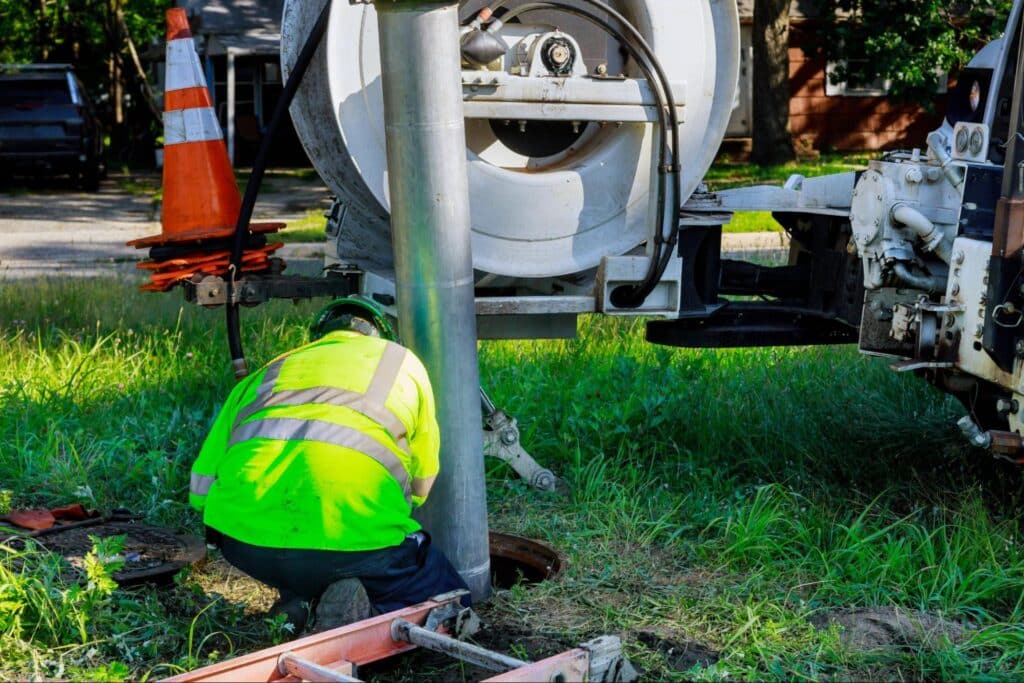
Regardless of the approach, operator skill and jobsite controls play a major role in both results and risk. Operator safety practices such as correct tool selection, appropriate pressure settings, and the use of personal protective equipment help protect crews while reducing the chance of avoidable pipe damage.
When pipe condition is unknown—or when repeat blockages suggest underlying defects—video camera inspection is often the safest first step. It helps crews confirm what they’re dealing with (roots, solids, offsets, deterioration) before applying aggressive cutting or high-pressure water. During cleaning, experienced operators monitor for warning signs such as unusual resistance, changing debris, or flow irregularities and adjust technique accordingly.
Key best practices include:
- Match the method to the pipe condition: use conservative approaches for older or fragile lines.
- Use pressure and tooling intentionally: set jetting pressure/nozzle choice to the application, and avoid forcing mechanical tools through unknown restrictions.
- Verify outcomes when it matters: a final check (often via CCTV) can confirm the line is clear and support maintenance planning and documentation.
Ensuring Long-Term Sewer System Efficiency and Reliability
Choosing between hydro-jetting and traditional mechanical sewer cleaning is about more than simply unblocking a line—it’s about ensuring long-term performance and cost-effective management. Each method offers distinct advantages, and often, a hybrid approach provides the best overall outcomes. By carefully evaluating pipe conditions, blockage types, and overall system demands, you can choose a strategy that resolves current issues while reducing the risk of future complications.
For personalized advice on the most appropriate cleaning method for your system’s needs—and to explore a full range of equipment and services—contact Brown Equipment Company. With comprehensive maintenance programs, expert training, and custom solutions, their team stands ready to guide you toward more effective sewer system management.
At Brown Equipment Company, “Service First” isn’t just a saying — it’s a mindset. Watch the video below to learn about how Brown Equipment Company always thinks about the customer, and the customer experience before anything else.