
Purchasing specialized equipment for government operations is far from straightforward. Government agencies must balance strict regulations, limited budgets, and real operational needs. Whether acquiring sewer cleaning trucks or snow removal vehicles, the procurement process can lead to inefficiencies, increased costs, and public dissatisfaction if not managed properly.
This article highlights five frequent pitfalls in government equipment purchasing and offers actionable strategies to avoid them. By addressing challenges such as vague specifications, overemphasis on upfront costs, underestimating vendor support, disregarding implementation issues, and reactive purchasing practices, procurement teams can improve outcomes and ensure long-term value.
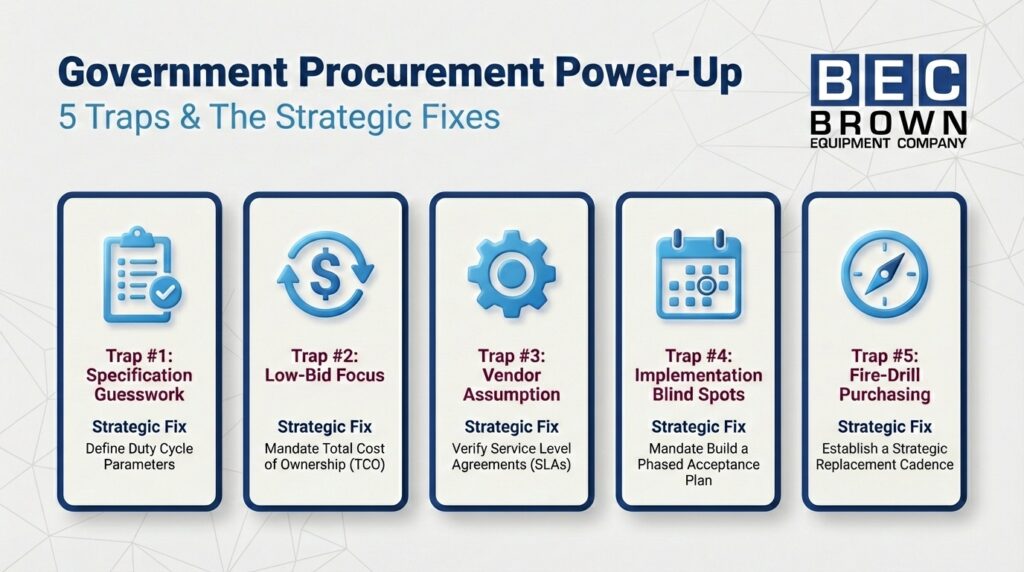
The 5 Most Common Pitfalls in Government Equipment Purchasing (Quick Summary)
Small procurement gaps can turn into big lifecycle costs. Here are the five pitfalls agencies run into most often:
- Vague Specifications: Generic requirements lead to equipment that doesn’t match real duty cycles, terrain, or attachment needs.
- Choosing Lowest Price Instead of Total Cost of Ownership (TCO): The cheapest purchase price often costs more once maintenance, downtime, training, and consumables are included.
- Treating Vendors as Interchangeable while Ignoring Support & Service Capacity: Service coverage, parts availability, training, and enforceable SLAs often determine long-term uptime.
- Overlooking Implementation Realities: Lead times, upfits, and unclear acceptance criteria are common causes of delays and performance disputes.
- Reactive Purchasing Instead of Strategic Fleet Planning: Emergency purchases drive higher costs and inconsistent fleets; lifecycle plans improve reliability and budget control.
Why These Pitfalls Happen in Public-Sector Purchasing
Public-sector equipment procurement involves numerous stakeholders and is subject to tough regulatory requirements. Multiple departments—such as finance, operations, and legal—must agree on specifications, and strict rules often slow decision-making. These factors can lead to generic requirements that fail to capture true operational needs. When equipment doesn’t match operational demands—be it for roadway & highway maintenance or wastewater management—public services suffer and trust in government processes is undermined.
Poor planning and lack of clear responsibilities can result in downtimes, missed deadlines, and increased expense. Careful coordination and thorough engagement with all stakeholders are essential to fully reflect the real-world demands of public agencies.
Pitfall #1 — Creating Specifications That Don’t Reflect Real-World Needs
Clear, specific requirements are vital to any procurement. Vague or incomplete specifications can result in equipment that does not meet operational demands.
Signs of Poorly Written Specifications
- Vagueness: Statements like “street sweeper” without details on terrain or performance expectations.
- Omissions: Failing to detail hours of operation, environmental conditions, or required support services.
Avoiding Mismatched Specifications
When specifications do not reflect actual use, equipment underperforms, leading to downtime and extra costs. Instead of general descriptions, the Request for Proposal (RFP) should include:
- Specific operating conditions and performance criteria.
- Requirements for attachments, duty cycles, and operator skills.
- Documentation like warranty details and service plans.
Actionable Strategy: Use a Detailed Specification Template
Create a standardized template that captures:
- Operational Environment: Road types, climate, and terrain.
- Usage Metrics: Load capacities, hours of operation, and performance expectations.
- Support Requirements: Training, warranty, and service expectations.
This proactive approach reduces ambiguity and helps ensure the equipment procured meets the true demands of public service.
Pitfall #2 — Focusing on Lowest Upfront Price Instead of Long-Term Value
While budget constraints are critical, concentrating solely on upfront cost can be misleading. Low-priced equipment may incur higher maintenance, training, and operational expenses over its lifecycle.
Understanding Hidden Long-Term Costs
Initial price barely scratches the surface of total costs. Consider:
- Maintenance and Repairs: Poor-quality equipment may require frequent, costly servicing.
- Operational Downtime: Equipment failures disrupt services and incur additional expenses.
- Training Needs: Complex systems often require extensive operator retraining.
- Consumables and Depreciation: High consumable costs and low resale value add to long-term expenses.
Prioritizing Total Cost of Ownership (TCO)
A TCO approach examines all lifecycle costs:
- Purchase price
- Ongoing maintenance, repairs, and consumables
- Training and support expenses
- Resale or disposal value
Mandate that bidders provide detailed TCO data so that procurement decisions are informed by the full financial picture.
Actionable Solutions for Lifecycle Cost Evaluation
- Require TCO Data: Ask vendors to detail all anticipated costs.
- Benchmark Against Performance Data: Use historical data or case studies to verify claims.
- Evaluate Warranty Terms: Warranty and support agreements help mitigate future expenses.
Focusing on long-term value ensures procurement decisions save money over the equipment’s entire lifecycle.
Pitfall #3 — Treating Vendors as Interchangeable and Overlooking After-Sale Support
It is a mistake to view vendors solely as price competitors. The quality of after-sale support often determines whether equipment remains reliable and effective over time.
What After-Sale Support Should Include
Robust vendor support typically offers:
- Rapid spare parts delivery.
- Access to local technicians or repair teams.
- Clear service-level agreements (SLAs).
- Comprehensive operator and maintenance training.
For specialized maintenance & repairs, agencies need a vendor equipped to quickly handle mechanical issues to keep fleets running.
The Cost of Inadequate Vendor Support
Weak support can leave agencies with equipment that is difficult to repair, leading to prolonged downtimes, disrupted public services, and unplanned emergency costs.
Building Vendor Assessment into Procurement
- Assess Local Service Networks: Verify vendor capability for timely local repairs or efficient logistics.
- Set Clear SLAs: Define measurable criteria like delivery times and technician response.
- Request Performance References: Evaluate vendor reliability through previous contracts and testimonials.
Incorporating after-sale support into vendor evaluations ensures continuous reliability with minimal surprises.
At Brown Equipment Company, “Service First” isn’t just a saying — it’s a mindset. Watch the video below to learn about our commitment to quality and customer satisfaction, and see firsthand why Brown Equipment Company is the trusted partner for professionals across industries.
Pitfall #4 — Overlooking Implementation Realities: Lead Times, Upfits, and Acceptance
Even great equipment can fall short if the implementation phase is mismanaged. Successful procurement is not only about product selection; it must also address delivery schedules, customization, and final acceptance.
Key Implementation Challenges
- Long Production Lead Times: Manufacturing or shipping delays.
- Upfitting Requirements: Custom modifications can complicate the timeline.
- Acceptance Procedures: Rushing final inspections can lead to unforeseen performance issues.
Agencies often need custom builds & fabrication to optimize asset performance or adapt equipment for unique operational conditions.
Ensuring Successful Implementation
Focus on building a comprehensive delivery and acceptance plan:
- Set Realistic Timelines: Work with vendors to define milestone-driven schedules.
- Plan for Upfits: Communicate any modifications early and coordinate thoroughly.
- Define Acceptance Criteria: Use a standardized checklist for inspections, performance tests, and training sessions.
Actionable Steps for Smooth Implementation
- Develop a Timeline with Milestones: Include production, delivery, and upfit completion dates.
- Maintain Regular Communication: Schedule periodic updates to manage potential delays.
- Prepare an Acceptance Checklist: Include testing, documentation verification, and training approvals.
Detailed implementation planning reduces delays, encourages proactive problem solving, and ensures your equipment is ready for service.
Pitfall #5 — Reactive Equipment Purchasing Instead of Strategic Fleet Management
Many agencies make emergency equipment purchases without aligning them with long-term fleet management strategies. Reactive buying often increases costs and results in a disjointed fleet.
The Drawbacks of Reactive Purchasing
- Higher Costs: Urgent needs may compel agencies to pay premium rates.
- Inconsistent Fleet Operations: Varying models complicate maintenance and training.
- Lack of Long-Term Planning: Reactive decisions disrupt operating schedules and budgets.
Unplanned acquisitions of specialized gear can strain budgets and limit opportunities for negotiated savings.
The Benefits of Proactive Fleet Management
A proactive approach involves anticipating purchase timing and maintenance requirements:
- Budget Stability: Spread out equipment investments over time.
- Vendor Leverage: Planned purchases encourage competitive bidding.
- Fleet Uniformity: Consistent models simplify maintenance and operator training.
Agencies might also consider reconditioning older assets to extend their lifecycle without incurring full replacement costs.
Actionable Strategies for Strategic Fleet Management
- Develop an Equipment Lifecycle Plan: Track usage and schedule replacements strategically.
- Create a Replacement Schedule: Align timing with budget cycles and operational needs.
- Standardize Equipment Purchases: Reduces training burdens and eases parts procurement.
- Use Fleet Management Software: Monitor assets and schedule maintenance efficiently.
By anticipating needs and planning systematically, agencies can minimize both emergency costs and downtime.

Practical Tools for Avoiding Procurement Pitfalls
Successful procurement relies on proactive planning and structured evaluation. Below are concise checklists for pre-bid preparation, bid evaluation, and post-award implementation. Take advantage of live demonstrations whenever possible to confirm operational suitability.
Pre-Bid Checklist
- Engage Stakeholders: Gather input from end users, fleet managers, and maintenance teams.
- Define Detailed Specifications: Establish environmental factors, performance metrics, and duty cycles.
- Confirm Funding and Timelines: Ensure budget approvals and align with regulatory schedules.
- Set Clear Evaluation Criteria: Identify metrics for TCO, vendor support, and compliance.
Bid Evaluation Checklist
- Assess Total Cost of Ownership (TCO): Account for all lifecycle costs, not just bid prices.
- Confirm Specification Compliance: Verify bids meet your operational requirements.
- Evaluate After-Sale Support: Review vendor history, SLAs, and maintenance services.
- Review Vendor Demonstrations: Check product claims through references or tests.
- Verify Service Agreements: Ensure measurable SLAs are outlined in proposals.
Post-Award Checklist
- Develop a Detailed Implementation Timeline: Outline delivery, upfits, and acceptance milestones.
- Organize Training: Schedule sessions for operators and maintenance staff.
- Conduct Thorough Inspections: Validate the equipment against stated specs before acceptance.
- Establish Ongoing Evaluation: Plan follow-up checks and maintain vendor accountability.
Use Digital Tools & Data Analytics to Strengthen Specs, Scoring, and Accountability

Digital tools aren’t just “nice to have”—they help agencies make procurement decisions that are easier to defend, easier to manage, and less likely to create surprises after award. The biggest wins come from using systems that centralize information and turn past fleet performance into better requirements and more accurate evaluations.
Practical ways to apply digital tools in procurement:
- Build a specification library: Store proven spec language (duty cycles, operating conditions, options, training requirements) so future RFPs start from a validated baseline.
- Standardize bid evaluation: Use scoring templates that capture compliance, TCO inputs, warranty coverage, service response expectations, and delivery timelines—reducing subjective decision-making.
- Track vendor and equipment performance: Maintain records on downtime, warranty claims, parts lead times, and service responsiveness to inform future awards and renewals.
- Support audits and protests: Keep version-controlled documentation (requirements, addenda, evaluation notes, justification memos) to demonstrate a fair, consistent process.
- Improve lifecycle planning: Use maintenance history and utilization data to forecast replacement windows and budget needs—preventing last-minute, premium-cost purchases.
Even a simple shared dashboard or centralized folder structure can improve consistency—full fleet platforms just make it easier to scale.
Improve Stakeholder Collaboration to Prevent Spec Gaps and Implementation Delays
Many procurement issues aren’t caused by “bad bids”—they happen when key stakeholders aren’t aligned early enough. Bringing finance, operations, maintenance, safety, and end users into the process upfront helps ensure the final equipment selection is serviceable, supportable, and ready to deploy on schedule.
Practical ways to make collaboration actionable:
- Hold a pre-RFP requirements workshop: Confirm duty cycle, operating conditions, storage constraints, training needs, and must-have options before specs are finalized.
- Assign clear ownership (RACI-style): Define who is Responsible, Accountable, Consulted, and Informed for specs, evaluation, acceptance testing, and training sign-offs.
- Use structured feedback from the field: Capture input from operators and technicians (what fails, what slows work, what’s hard to maintain) and turn it into measurable requirements.
- Align acceptance criteria early: Agree on inspection steps, performance tests, documentation requirements, and training completion before delivery—so acceptance isn’t rushed or subjective.
- Schedule recurring check-ins post-award: Short, milestone-based meetings during build, upfit, delivery, and commissioning help catch delays and scope issues before they become emergencies.
If you only add one step, make it a cross-functional sign-off on the spec package and the acceptance checklist—those two gates prevent most downstream surprises.
Strategic Approaches for Effective Government Equipment Procurement
Navigating government equipment procurement requires a strategic, well-informed approach. Vague specifications, an overemphasis on upfront cost, neglect of vendor support, overlooked implementation challenges, and reactive purchasing all disrupt operations and strain budgets. By focusing on clear requirements, total lifecycle value, robust after-sale support, detailed implementation plans, and proactive fleet management, agencies can overcome these pitfalls.
A well-planned procurement process ensures your organization offers reliable public services while saving costs over the long term. By combining structured evaluation with digital tools and a commitment to continuous improvement, agencies stay prepared for evolving regulations and service demands.
Contact Brown Equipment Company today to learn how strategic procurement can bring lasting value to your organization.