Effective snow and ice management is crucial for municipalities maintaining safe roadways while optimizing budgets and meeting environmental standards. When it comes to brine vs salt for roads, these two widely used methods offer distinct advantages and challenges. This guide provides a detailed, focused comparison to help municipal leaders and public works professionals decide which approach, or combination of methods, best meets their operational and sustainability goals.
Why This Decision Is More Complex Than “Liquid vs. Rock Salt”
Choosing between liquid brine systems and salt spreading isn’t simply a matter of liquid versus granular materials. Municipal teams must consider public safety expectations, tight budgets, staffing demands, environmental mandates, and long-term costs such as infrastructure corrosion.
Meeting Public Expectations
Residents demand safe, clear roads regardless of storm severity. Liquid brine systems require proactive, precisely timed applications to prevent ice bonding, while salt spreading is typically reactive, applied during or after storms. Balancing fast responses with consistent quality is a key challenge.
Balancing Budgets and Resources
Municipalities often operate under severe budget constraints. Liquid brine methods involve upfront investments in equipment like brine makers, storage tanks, and spray rigs, and require specialized training. Traditional salt spreading usually uses existing infrastructure but may incur higher operational costs due to inefficient material placement and repeated applications.
Addressing Environmental Compliance
Both approaches contribute to chloride runoff that can degrade water quality and damage soil. Brine’s controlled application often uses less total salt compared to granular spread, potentially reducing environmental impacts. Regardless of the method, proper calibration, timing, and monitoring are essential to minimize over-application.
Considering Hidden Costs
Granular salt’s inefficiencies—such as bounce, scatter, and over-application—increase material waste, labor, fuel, and repairs due to corrosion. Although liquid brine systems demand a higher initial investment, they can reduce these hidden costs if managed correctly.
Defining the Options: Understanding Brine Systems and Traditional Salt Spreaders
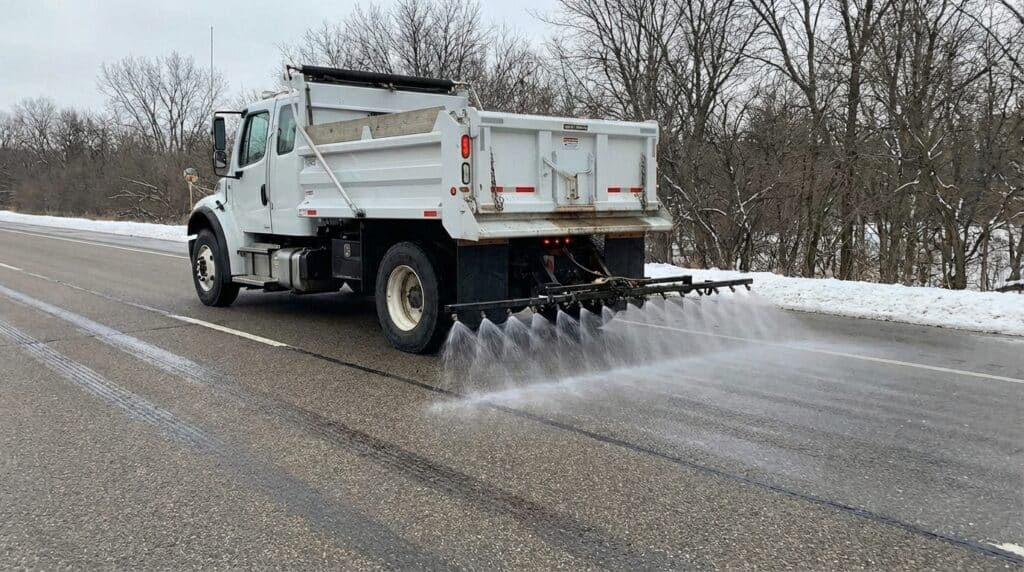
A clear understanding of how each system works is crucial to determining the best fit.
What Are Brine Systems?
Liquid brine de-icing uses a water-based solution (typically about 23% sodium chloride) to prevent or break ice formation. Municipalities can produce brine on-site or purchase it, storing the solution in dedicated tanks for anti-icing. Solutions like the Brine Masters™ Continuum™ Series allow municipalities to produce consistent, accurately calibrated brine on-site. This proactive tactic helps stop snow from bonding to pavement, ensuring fewer reapplications once precipitation starts.
What Are Traditional Salt Spreaders?
Traditional salt spreaders apply granular rock salt to melt existing snow and ice. There are several techniques:
- Dry salt, which can scatter and result in wasted material.
- Pre-wet salt, in which granules are coated with a small amount of liquid to improve adhesion.
- Treated salt, mixed with additives like magnesium or calcium chloride for better performance.
This reactive approach remains familiar to many municipalities where equipment for granular salt is already in place.
Comparing Anti-Icing, De-Icing, and Pre-Wetting
- Anti-icing: Applied before precipitation to prevent ice formation, minimizing material use.
- De-icing: Uses salt after snow or ice accumulates, typically requiring greater amounts of material.
- Pre-wetting: Coats granular salt with a liquid brine to improve performance, reducing scatter and increasing adherence to road surfaces.
Efficiency Comparison: Time, Coverage, and Performance
Several factors—material placement, timing, coverage consistency, and weather—determine overall efficiency.
Material Placement and Minimizing Loss
Advanced brine systems apply a liquid that flows into road cracks and adheres evenly. Granular salt, on the other hand, can bounce off surfaces, causing material loss and necessitating additional passes.
Timing of Applications
Liquid anti-icing solutions are applied proactively, forming a barrier that prevents snowpack and ice from bonding to pavement. Traditional granular salt is applied during or after the onset of winter weather, often delaying safe road clearance.
Consistency of Coverage
Liquids are distributed evenly across the road surface, reaching into cracks and low spots that otherwise remain untreated with granular methods. By contrast, scattered salt may result in inconsistent coverage and patches of ice.
Performance Across Weather Conditions
Brine is most effective in moderate winter temperatures (approximately 15–30°F). In extremely cold conditions below 10°F, treated granular salts can sometimes outperform liquids, though this often comes with increased material consumption and higher resource input.
Enhancing Route Productivity
By reducing reapplications and material scatter, brine systems improve overall productivity, decrease fuel consumption, and lower labor costs. Operators can often cover more lane miles in fewer passes, increasing efficiency.
Cost Comparison: Initial Investment, Operational Costs, and Long-Term Value
Financial decisions should factor in both upfront and ongoing costs.
Upfront Equipment Costs
- Brine systems: Require purchasing or leasing brine makers, storage tanks, sprayers, and training.
- Salt spreaders: Typically already exist in many fleets, but upgrading them (e.g., adding pre-wet capability) can involve added costs.
Operational Costs
Liquid brine approaches can reduce material usage by an average of 23%, according to a University of Wisconsin-Madison study. Fewer passes and lower salt consumption translate to reduced labor, fuel, and maintenance over time. By contrast, traditional salt spreading can be prone to over-application.
Storage and Logistics
Liquids necessitate dedicated storage tanks and pump systems, potentially streamlining operations and reducing reliance on large salt stockpiles. Granular salt generally needs more space for piles and may slow response times due to extra loading steps.
Long-Term Infrastructure Impact
Precision in applying liquid brine can help curb chloride runoff and limit corrosive damage to roads, bridges, and municipal vehicles. Over time, frequent granular salt applications can accelerate infrastructure deterioration, elevating future repair costs.
Simple Cost Analysis Model
Municipalities can quantify costs by examining expense per lane mile for an entire season. This figure should encompass equipment depreciation, materials, labor, fuel, and long-term maintenance. While liquid solutions carry higher upfront costs, the diminished material usage and infrastructure wear can deliver greater value over the lifespan of the program.
Environmental Impact: Reducing Chloride Levels and Runoff
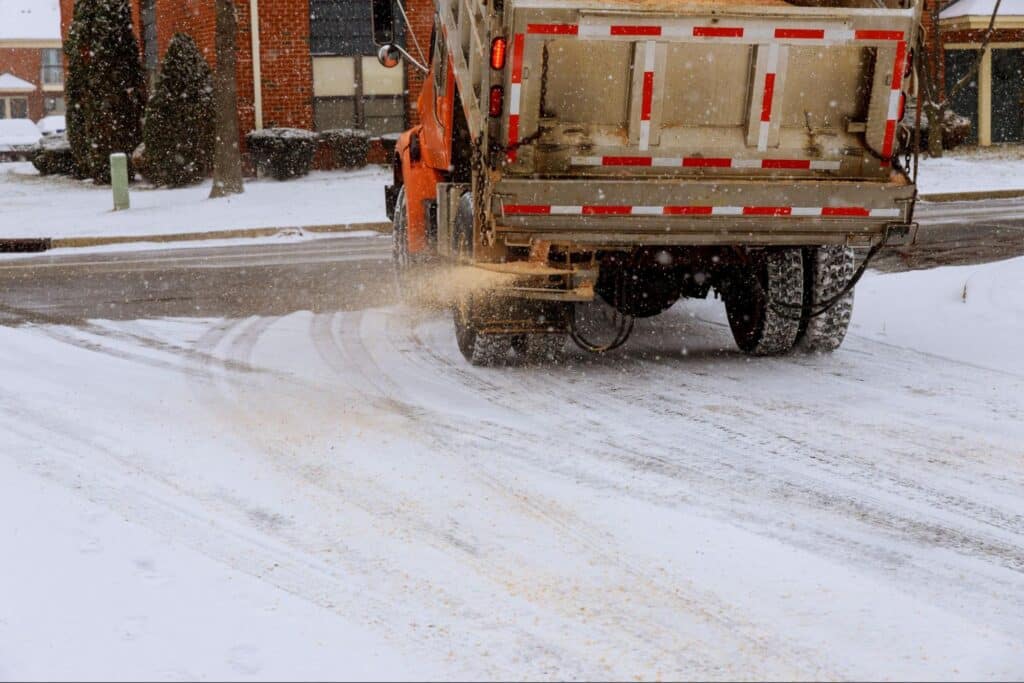
Lowering chloride runoff is essential for protecting local water sources and ecosystems.
Importance of Reducing Chlorides
Both methods introduce chlorides into the environment, but brine’s controlled application can cut overall usage. Even so, mindful spraying, effective storage, and thorough operator training are crucial to preventing unintentional overuse.
Managing Runoff Risks
Excess salt in traditional methods can be washed into storm drains and waterways. With calibrated liquid applications, municipalities can better manage the chloride levels applied per lane mile, which helps mitigate environmental damage. For more on the environmental impacts of road salt, see this EPA overview on road salt and water quality.
Practical Mitigation Steps
- Calibrate spreaders and sprayers at the start of each season.
- Monitor road and weather conditions continuously.
- Record material usage to identify waste and refine future applications.
- Train operators on correct and precise application methods.
- Follow American Public Works Association recommendations for sustainable winter maintenance.
Choosing the Right Approach: Scenarios and Recommendations
Decision-makers must consider geography, climate, goals, and any unique local constraints.
When to Choose Brine Systems
- Mild to moderate temperatures (15–30°F).
- Emphasis on preventative anti-icing.
- Prioritization of environmental directives and lower chloride runoff.
- Sufficient budget for training and upfront equipment costs.
- Frequent light to moderate snowfalls allowing proactive treatments.
When to Use Traditional Salt Spreaders
- Very cold temperatures (below 10°F).
- Heavy snowfall or complex terrain where granular salts are needed for thicker accumulations.
- Minimal funding for new equipment.
- Existing granular-based setups that meet immediate operational demands.
- Remote or less-trafficked areas where logistical challenges make liquids less practical.
Hybrid Approaches
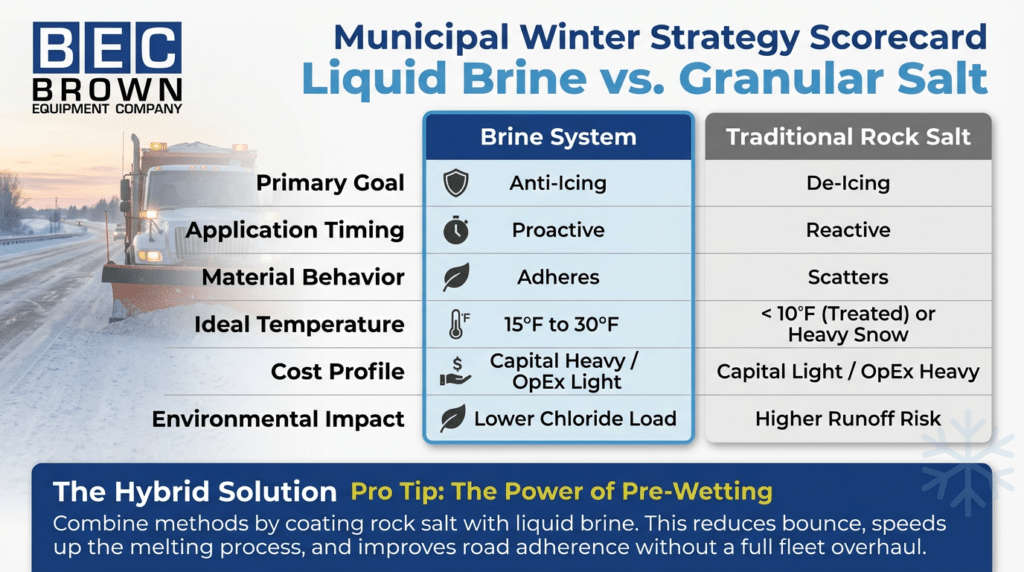
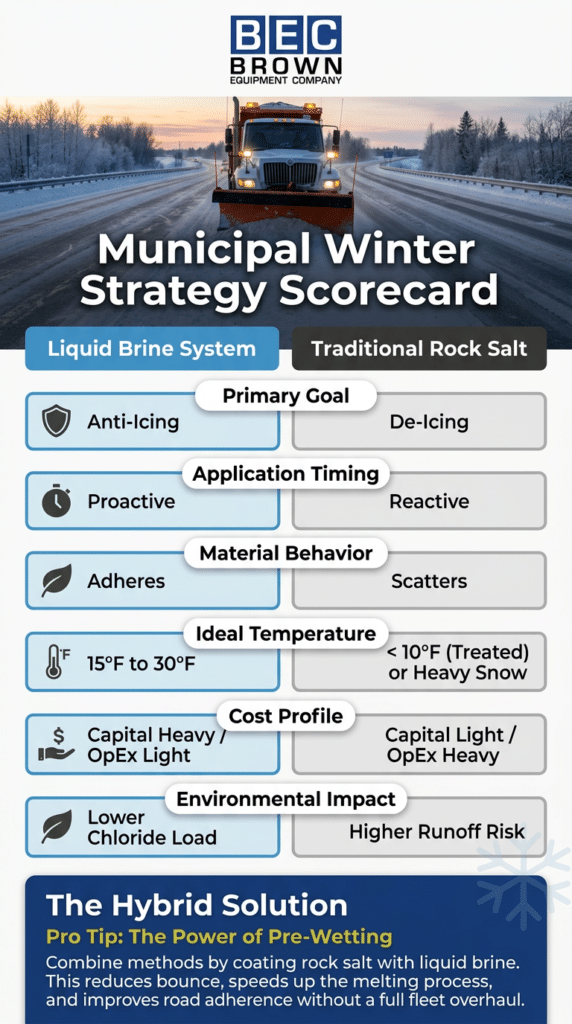
Municipalities often blend both techniques. Early anti-icing with liquids can minimize bonding, while treated salt addresses snowpack in more severe conditions. Pre-wetting granular salt with brine also helps retain salt on the roadway, offering an adaptable and cost-effective system.
Implementation Checklist: Getting City-Ready
Rolling out a robust snow and ice management program demands coordinated planning, training, and equipment upkeep.
People: Training and Procedures
- Train operators in brine production, system calibration, and understanding both preemptive versus reactive strategies.
- Develop standard operating procedures (SOPs) detailing proper application rates and conditions.
Processes: Route Optimization and Communication
- Map critical routes first—high-traffic corridors, bridges, and major intersections.
- Collect data on weather, material usage, and road conditions to refine future decision-making.
Equipment: Maintenance and Upkeep
- Inspect brine makers, storage tanks, and spray rigs before the winter season. Brown Equipment Company offers maintenance, service, and parts support to keep your winter equipment running all season.
- Calibrate salt spreaders for precision, especially if incorporating pre-wetting.
- Schedule proactive maintenance to limit in-season downtime.
Monitoring and Measurement
- Measure operational benchmarks like cost per lane mile, response times, and materials usage.
- Integrate technology such as GPS tracking and sensors to streamline workflows.
FAQ about Brine Systems vs. Salt Spreading
What’s the difference between a brine system and a traditional salt spreader?
A brine system applies liquid salt brine (commonly around 23% sodium chloride) for anti-icing and light de-icing. A traditional salt spreader applies granular rock salt (dry, pre-wet, or treated) primarily for de-icing after snow or ice has already accumulated.
Is brine better than rock salt for city roads?
Brine is often better for preventing ice from bonding to pavement when applied proactively before a storm. Rock salt is more commonly used reactively during or after storms and can be preferred in very cold weather or heavier accumulation. Many municipalities use both methods to maintain service levels while controlling costs and salt use.
When should a city use liquid brine versus salt spreading?
Use liquid brine for anti-icing before precipitation to reduce bonding and cut down on repeat applications. Use salt spreading for de-icing once snow and ice have accumulated, during active storms, or when conditions make proactive brine timing difficult.
What temperature is brine most effective in?
Brine typically performs best in moderate winter temperatures, often around 15–30°F. In very cold conditions (commonly below about 10°F), treated granular products or alternative deicers may be required to maintain melting performance.
Does brine reduce salt usage compared to granular spreading?
Often yes. Brine is applied more evenly and avoids common granular losses like bounce and scatter. With proper calibration and timing, municipalities can frequently reduce overall salt usage and improve route productivity compared with repeated granular applications.
What is pre-wetting salt, and how does it improve performance?
Pre-wetting applies a small amount of liquid (often brine) to granular salt as it’s spread. This helps salt stick to the roadway, reduces bounce and scatter, and can increase melting effectiveness—often allowing better results with less material.
Is a brine system cheaper than salt spreading for municipalities?
Brine programs can cost more upfront due to brine makers, tanks, spray equipment, and training. However, they may reduce long-term operating costs by lowering salt use, decreasing labor and fuel from fewer passes, and helping limit infrastructure wear. A strong comparison metric is total seasonal cost per lane mile, including materials, labor, fuel, and equipment maintenance.
Evaluating and Implementing Effective Snow and Ice Management Strategies
When weighing brine vs salt for roads, both liquid brine systems and traditional salt spreading can be effective for municipal snow and ice management, but each has distinct advantages. Brine systems provide proactive coverage and can reduce overall chloride usage in moderate temperatures, while granular salt may be more suitable for very cold conditions and for leveraging existing equipment setups. In many cases, a hybrid strategy delivers the best of both worlds.
When implemented with proper planning, training, and monitoring, these methods help municipalities achieve safe, efficient, and sustainable winter maintenance.
Ready to upgrade your winter maintenance program? Brown Equipment Company provides municipal teams with industry-leading brine production systems, material spreaders, and full-service support — from equipment selection to installation and ongoing maintenance. Contact an equipment consultant to find the right solution for your fleet.